

What does it mean to lead like a Sikh? Across the globe, Sikh professionals, executives, and entrepreneurs are drawing on timeless spiritual principles — service (seva), justice (nyaya), humility (nimrata), and resilience (chardi kala) — to shape a distinct and values-driven approach to leadership.
This collaborative resource page curates some of the most insightful tools, articles, and programs available for Sikh leaders — from academic research to professional mentorship to purpose-driven retreats. We also include original pages from TalentWhisperers that explore Sikh inner voices, saboteurs, and the journey of transformation.
Table of Contents
- Sikh Leadership Principles & Ethics
- Sikh Leadership Development Programs
- Sikh Professional Networks & Support
- Related Talent Whisperers Explorations
- See Also: External References
Sikh Leadership Principles & Ethics
1. Theorising Business Ethics Through a Sikh Lens (IDEAS)
An academic paper exploring how Sikh teachings (Gurmat) influence stakeholder-centered business ethics and moral leadership.
2. Ethics and Business: Evidence from Sikh Religion (IIM Bangalore)
This research paper examines how Sikh scriptural principles shape ethical decisions in commerce, management, and governance.
3. Sikh Leadership and the Code of Conduct (TalentWhisperers)
A reflection on how the Sikh Rehat Maryada (Code of Conduct) offers a framework for integrity, courage, and compassion in executive roles.
Sikh Leadership Development Programs
4. SikhLEAD (SALDEF)
A structured program for emerging Sikh American leaders, combining mentorship, public service, and professional training.
5. Sidak Leadership Program (SikhRI)
A deep dive into Sikh history, Gurbani, and applied ethics — ideal for mid-career professionals seeking purpose and clarity.
6. Sikhs Without Borders
Global service-based programs combining Sikh identity and social entrepreneurship for the next generation of leaders.
Sikh Professional Networks & Support
7. City Sikhs (UK)
A leading network for British Sikh professionals offering advocacy, mentorship, and community for Sikh leaders.
8. Basics of Sikhi (Everythings13)
Educational videos, talks, and courses that provide a strong philosophical foundation for Sikh values in life and leadership.
Related Talent Whisperers Explorations
TalentWhisperers.com is a site dedicated to help in the areas of leadership and leadership coaching. Several pages and sections within documents have been dedicated at taking a closer look at various things though the lens of Sikh belief and traditions. HumanTransformation.com and AtomicRituals.com are related sister sites.

9. A Next Level Strength: A Sikh Perspective (Talent Whisperers).
An in-depth look at Chardi Kala as a force for transcendent optimism, leadership endurance, and emotional resilience.
10. The Turban and the Title (Talent Whisperers).
Leadership as sacred responsibility in visible roles. The Turban and Title analogy is explored here. In Sikh tradition, wearing a turban is not merely a religious symbol. It is a public declaration of identity, honor, and accountability. To tie one’s turban each day is to visibly affirm one’s values. It signals to the world: this is who I am, this is what I stand for.
11. Sikh Wisdom for Weathering Storms (Talent Whisperers).
This page explores how Sikh teachings—Chardi Kala (ever-rising spirit), Seva (selfless service), Naam Simran (remembrance), and the Five Virtues—can inform each core section of the Weathering Storms navigational framework. For Sikh professionals, these principles are not abstract ideals. They are daily disciplines—anchoring decisions, stabilizing teams, and elevating leadership through grace and grit alike.
12. Atomic Rituals as Seen through a Sikh Lens (Atomic Rituals).
In Sikh tradition, transformation is not a sudden overhaul but a disciplined, conscious evolution. Sikhism teaches that divinity lies in the everyday—in actions repeated with mindfulness, in service done without ego, and in resilience shown during challenge. These same values echo powerfully in the framework of Atomic Rituals.
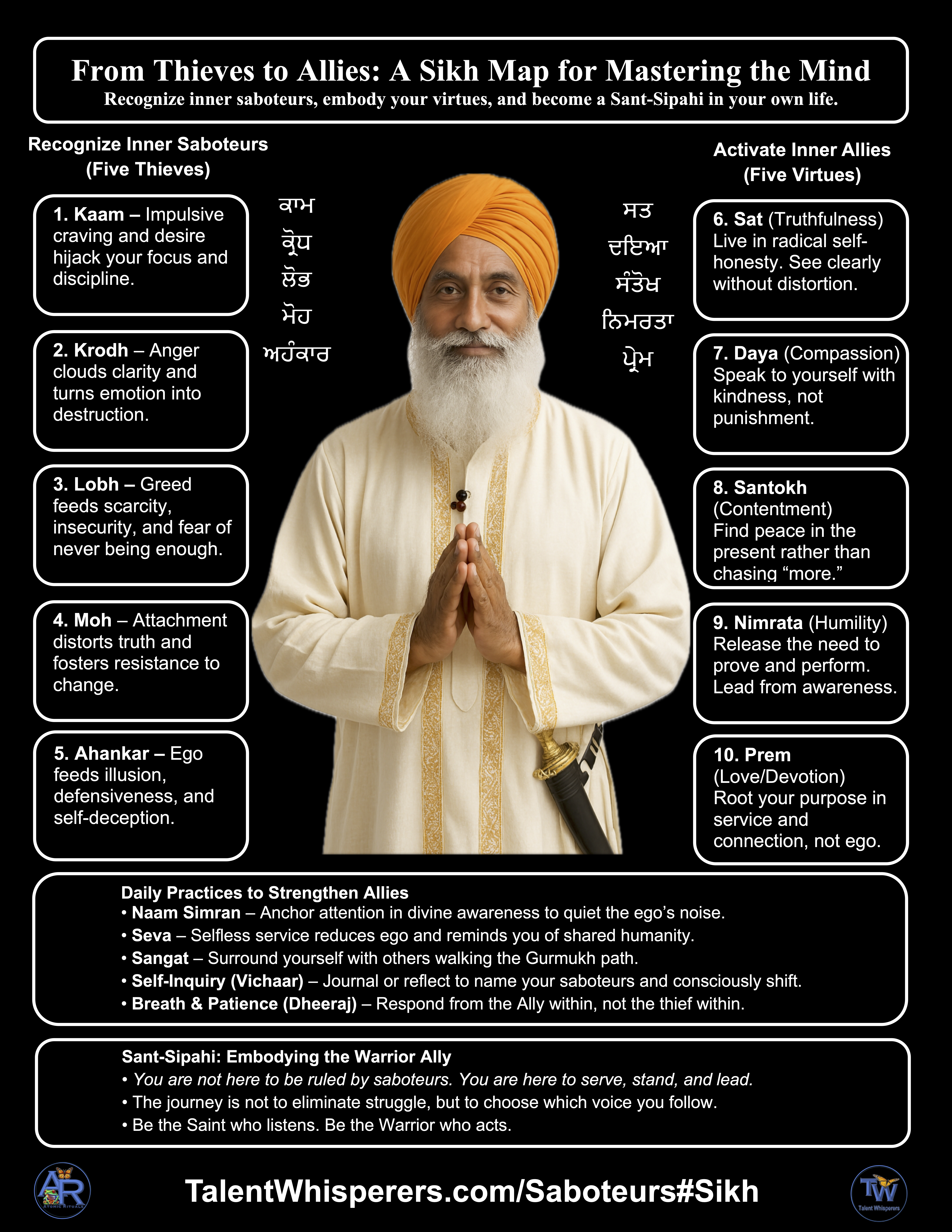
13. From Thieves to Allies: A Sikh Map for Mastering the Mind (Talent Whisperers).
In Sikh philosophy, the battle between inner voices—those that empower us and those that hinder us—is deeply explored through spiritual teachings, historical narratives, and meditative practices. The Sikh perspective offers a profound lens on recognizing and transforming the saboteurs within, aligning one’s inner voice with truth, courage, and divine connection.
14. From Thieves to Allies: A Sikh Map for Mastering the Mind (Talent Whisperers Infographic)
Visual guide exploring the five inner “thieves” and five balancing virtues, reflecting saboteur and ally dynamics in Sikh teachings.
15. Learned Resilience in the Eyes of a Sikh (Talent Whisperers).
Sikh resilience is a powerful human trait. esilience is a powerful human trait. For Sikhs, this quality is deeply woven into their spiritual and historical fabric. It is not merely about enduring hardship. Instead, Sikh resilience involves the active cultivation of spirit. This profound strength stems from core principles. A unique philosophy called Chardi Kala expresses this strength.
16. The Individual Journey Through the Lens of Sikh Belief (Human Transformation).
In Sikhism, the journey of an individual is deeply spiritual and purpose-driven, rooted in the recognition of divine presence within oneself and the universe. This journey is not solitary; it is both personal and universal, reflecting Sikhism’s emphasis on the interconnectedness of all life through the concept of Ik Onkar (One Creator). Sikh teachings encourage us to explore this path through self-reflection, service, and alignment with divine will.
17. The Collective Journey in Sikh Belief (Human Transformation).
In Sikhism, the concept of a collective journey is deeply interwoven with the principles of community and unity. Known as Sangat (holy congregation), this idea emphasizes that spiritual growth is not just an individual pursuit but a shared experience. The collective journey highlights how coming together with others strengthens faith, fosters compassion, and brings us closer to the divine.
18. Sikh Wisdom for Healing and Resilience (Talent Whisperers).
Offers a gentle path for navigating challenge, burnout, and personal struggle through Sikh perspectives on sound, rest, and self-compassion.
19. The Divine Rabab (Human Transformation).
Explores the notion that Sikh belief offers a profound understanding of the relationship between humanity and the Divine through the metaphor of The Musician, the Song, and the Divine Rabab. Music holds a sacred place in Sikhism, with Gurbani Kirtan (devotional singing) being central to spiritual practice. This metaphor explores the interplay between the individual, the divine, and the harmony that results when one aligns with divine wisdom.
20. Talent Whisperers Through a Sikh Lens (Talent Whisperers).
Explores the Essence of a Talent Whisperer in the context of Sikh belief. The Whisper, the Sword, and the Vow — different expressions of the same sacred duty: to see the divine in others, and to help them see it in themselves.
21. Co-Active Coaching and Sikh Wisdom (Talent Whisperers).
A guide for coaches and clients exploring intersections between Sikh beliefs and coaching principles like wholeness, presence, and transformation.
This evolving resource is meant to support Sikh leaders at every stage — whether you’re just beginning your journey, seeking to lead from your values, or mentoring the next generation. Want to suggest a resource? Let us know.
Appendix: Talent Whisperers Through a Sikh Lens

1. Seva (Selfless Service) as Developmental Leadership
In Sikhism, leadership is not about status — it’s about service. A true leader elevates others through seva. Similarly, a Talent Whisperer doesn’t command or control; they serve the growth of others without ego or agenda.
“The one who serves selflessly, they alone find honor.” — Guru Granth Sahib (Ang 286)
Sikh tradition honors those who nurture others’ gifts — not for personal gain, but as an expression of divine purpose.
2. Naam and Simran: Listening for the True Self
Talent Whisperers listen deeply — for what is unspoken, what is emerging. This parallels Naam Simran, the meditative practice of attuning to divine presence within.
To whisper talent is to believe, like Sikhism teaches, that everyone carries a spark of the divine — a truth often obscured by saboteur voices or worldly noise. The role is to help remove those coverings so that the person may shine.
3. Gurmat Wisdom: The Teacher is Within
Sikhi reminds us that the true teacher (Guru) doesn’t impose knowledge — the Guru awakens it. A Talent Whisperer doesn’t dictate success. They help people remember who they are, and lead themselves from within.
This is mirrored in the Sikh view of gurmat — living aligned with divine wisdom, not external coercion.
4. Compassion + Justice = Powerful Allyship
Sikh warriors are taught to be saint-soldiers — fierce in defense of truth, and tender in care. A Talent Whisperer mirrors this duality:
- They challenge people to grow (justice)
- They hold space for imperfection (compassion)
This fusion — fierce love — is at the heart of Sikh ideals of leadership, particularly visible in the Khalsa tradition.
5. Chardi Kala: Uplifting Others as a Form of Worship
A Talent Whisperer operates in Chardi Kala — not just optimism, but resilient elevation. Sikhism sees uplifting others as a sacred act. Even amid difficulty, one must choose courage, joy, and hope — not just for oneself, but as a gift to others.
That’s the whisper: not of critique or command, but of soulful encouragement rooted in eternal values.
6. Sehaj Soch: The Perpetual Learner’s Mindset
In Sikh practice, true wisdom comes not from mastery, but from continual alignment with truth — a process of remembering, shedding ego, and returning to childlike openness (sehaj). Talent Whisperers live in this spirit: always learning, always evolving. They are not gurus atop mountains. They are fellow travelers, always growing alongside those they guide. The whisper is one of humility: “I’m still learning too.”
Conclusion: The Talent Whisperer Is a Sikh Archetype in Disguise
In many ways, the role of a Talent Whisperer is a contemporary echo of the Sikh ideal: a servant-leader, a guide without ego, one who helps others hear the voice of their own Guru within.
Footnote: The Sikh-Talent Whisperer-Bodhisattva Parallel
There is a striking resonance across traditions: the Sikh leader guided by Rehat, the Talent Whisperer committed to calling forth potential, and the Bodhisattva who delays their own enlightenment to assist others — all walk paths of self-transcending service.
- The Sikh ideal is the saint-soldier — both compassionate and courageous, humble and just.
- The Talent Whisperer listens beyond ego to nurture others’ growth, quietly enabling transformation from within.
- The Bodhisattva cultivates wisdom and awareness, yet remains with the suffering world to guide others toward liberation.
All three share a commitment to ongoing learning, presence, non-judgment, and awakening in service of others.
The whisper, the sword, and the vow — different expressions of the same sacred duty: to see the divine in others, and to help them see it in themselves.
See Also
- Sikhism Through Its Scriptures (HarvardX)
A free online course exploring Sikh scripture and its influence on culture, practice, and identity. - Responding to Hate with Grace (Harvard Divinity School).
Examines Sikh responses to bias and misunderstanding, with relevance for public identity and leadership. - Compassion in Sikh Dharmic Tradition (SkhiNet).
Karuna (Compassion) is a foundational principle in Sikh teachings, transcending beyond a mere virtue to become a fundamental way of life. Sikh dharmic tradition, founded by Guru Nanak in the 15th century, emphasizes selfless service, equality, and justice, with compassion being a driving force behind all these ideals.