

Mamba Mentality and inner voices are all part of the Inner Game. Kobe Bryant’s famous philosophy is often reduced to relentless work ethic. But beneath the intensity was something more interesting: a system for learning and responding to what happens inside us under pressure. Kobe spoke openly about self-talk, self-doubt, fear, failure, pain, and injury. He sought weaknesses rather than hiding them. He studied opponents, dissected mistakes, practiced details, invited challenge, and returned to the work again and again. Failure did not have to become a verdict about who he was. It could become information about what to practice next.
Through that lens, Mamba Mentality offers more than motivation. It offers a model for training our inner voices and pursuing mastery through deliberate cycles of challenge, feedback, learning, and refinement.
Beyond “Work Harder”
The legendary workouts, obsessive preparation, competitiveness, and willingness to practice when others were sleeping certainly support the familiar interpretation of Kobe as someone willing to work extraordinarily hard. But “work harder” misses something essential. Kobe did not simply repeat what he already knew how to do. He studied and experimented. He noticed weaknesses, broke skills into details, watched film, and learned from coaches, teammates, opponents, successes, and misses.
His own book, The Mamba Mentality: How I Play, makes that analytical side unusually visible, documenting how closely he studied opponents, prepared mentally and physically, broke down specific matchups, and refined the craft itself.
That distinction matters because repetition alone can reinforce what we already do.
Deliberate repetition informed by feedback changes what we are capable of doing.
“The Mamba Mentality simply means trying to be the best version of yourself.” — Kobe Bryant
Kobe wasn’t talking only about talent or effort. He was talking about the Inner Game. Through the lens we explore here, Kobe’s biggest opponent wasn’t necessarily the work. It was often the voice inside, the voice telling him he might fail. That was the real battle. Pursuing something we deeply want means accepting that we could fall short. Holding something back can protect the ego: if we never commit fully, we never have to discover what might happen if we do. Kobe repeatedly chose to lean into that uncertainty. Fear wasn’t necessarily a stop sign. It could become a signal to commit, learn, adapt, and continue pursuing the best version of himself. That is the Mamba Mentality explored on this page.
A Note on Interpretation
This page is a Talent Whisperers® exploration of Mamba Mentality and Inner Voices, including possible connections to Learned Resilience, the THRIVE Loop, and related approaches to mastery. Unless explicitly quoted or attributed, the Saboteurs, Allies, mappings, and interpretations presented here are part of the Talent Whisperers lens, not terms or frameworks created or endorsed by Kobe Bryant.
I developed this exploration through an iterative research and writing process, using ChatGPT, Gemini, Copilot, and Claude as research and editorial collaborators to help locate and validate sources, seek contradictory evidence and alternative interpretations, test connections, challenge assumptions, and refine structure, language, images and infographics. Through thousands of iterations, I questioned, challenged, and shaped the interpretations presented here and take responsibility for what is ultimately published.
This exploration is offered as an invitation to curiosity, not as the final word on Kobe Bryant or Mamba Mentality. My hope is that Kobe’s words, practices, contradictions, and extraordinary pursuit of mastery might prompt us to become curious about his Inner Game, our own inner voices, and what each might teach us about learning and becoming. If you see something differently, discover another connection, question an interpretation, or have an experience that adds to the exploration, I welcome you to join the conversation in the comments below.
The intent is not to redefine Mamba Mentality, but to invite curiosity about what Kobe’s words, practices, and pursuit of mastery might teach us when viewed through these complementary lenses.
Table of Contents
- Mamba Mentality and Inner Voices: The Inner Game
- The Black Mamba: When Kobe Created Another Self to Answer the Moment
- Pressure as Information, Not Verdict
- Training Attention: Meditation, Mindfulness, and the Zone
- Kobe Bryant’s Self-Talk: From Silencing Doubt to Training the Voice That Answers It
- Mamba Mentality and Learned Resilience
- Study the Make, Study the Miss
- From Michael Jordan to Mamba: When Comparison Becomes Curriculum
- Mamba Mentality, Grover, and Relentlessness
- Constructive Obsession
- Mastery Has No Finish Line
- A Journey of Transformations
- The Mamba Within
- See Also
- Slides Of the Mamba Mentality Engine
The Shadow of Mastery
Mamba Mentality carried extraordinary power, but it also carried a cost. Kobe’s intensity could become isolating. His standards sometimes strained relationships. The same drive that fueled mastery also demanded sacrifice, time, recovery, ease, and sometimes connection. Todd Herman’s recollection of the Black Mamba ritual suggests another possible shadow. Herman, a performance coach and author, says he worked privately with Kobe on performance identity during this period. In Herman’s account, Kobe’s decision to enter the imagined cage carried, at least in part, an element of self-punishment connected with what had happened in his personal life. That is Herman’s interpretation rather than Kobe’s own description of the ritual, but it complicates any temptation to see the Black Mamba only as an elegant performance technique.
Naming this shadow does not diminish the brilliance of his pursuit; it clarifies it. Mastery is not free. It asks something of us. And part of training our inner voices is learning to recognize when intensity sharpens us and when it begins to consume us.
Thesis
Mamba Mentality was not simply about working harder, winning, or silencing doubt. It was a disciplined learning loop: seek challenge, prepare deeply, act fully, study the outcome, extract the lesson, refine the craft, and return more capable than before. And running through that loop was an Inner Game: learning to hear fear, doubt, pain, and failure without necessarily allowing the first voice that spoke to determine what happened next.
A Dialog Based on the Exploration Below
Mamba Mentality and Inner Voices: The Inner Game
Mastery begins inside. Before any visible performance changes, inner voices help shape what we attempt, avoid, or learn from.
Before mastery becomes visible in performance, another contest may be happening internally, through the self-talk, inner dialogue, and competing inner voices that shape how we interpret and respond to what happens. A missed shot can awaken Fear of Failure: Don’t take that shot again. Success can awaken the Comfort Seeker: You’ve already proved yourself. Watching someone better can trigger the Comparison Trap: You’ll never be as good as they are. Failure can awaken the Identity Defender: Don’t look too closely. What if this means you’re not actually good enough?
These voices do not necessarily disappear when someone becomes accomplished. If anything, greater accomplishment can raise the stakes attached to failure. Mastery may depend less upon permanently silencing those voices than upon which voices we train ourselves to follow when they appear.
Kobe came unusually close to describing this Inner Game himself. Asked which of five aspects of Mamba Mentality came first, he resisted separating them. “The reality is it’s all one thing,” he said, because “it all comes from within.” What mattered, he suggested, was awareness: “The key I feel is just to be aware of those moments as they occur.” He specifically described becoming aware of fear, obstacles, and challenges, and then learning to “navigate through them.”
That distinction matters. Mamba Mentality need not imply that fear or difficult inner voices disappear. Something can arise within us, we can become aware of it, and what happens next may still remain open to influence.
Mamba Mentality suggests a different response:
| Voices That Hold Us Back | Voices of Mamba Mentality |
|---|---|
| Fear of Failure — Don’t risk the miss. | Fearless Learner — Take the shot. Then study what happened. |
| Comfort Seeker — You’ve done enough. | Relentless Craftsman — There is always something left to refine. |
| Shortcut Seeker — Just get the result. | Process Devotee — Master the work that produces the result. |
| Comparison Trap — They’re better than you. | Relentless Student — Then learn what they know. |
| Excuse Protector — Conditions weren’t in your favor. | Radical Ownership — What was mine to control? |
| Identity Defender — Failure means something about who you are. | Growth Identity — Failure tells me what to work on next. |
The transformation is important. We do not necessarily have to destroy the saboteur. We can train another voice to lead.
Training Another Song to Play
Our Inner Jukebox offers another way to think about what it might mean to “train another voice to lead.” Perhaps all of these Saboteur and Ally songs already exist somewhere within our repertoire. The challenge is that they may not be equally loud or equally easy to find when pressure arrives.
The Saboteur song may get the first few notes. Fear of Failure says, Don’t risk the miss. Comparison Trap says, They’re better than you. Identity Defender warns, Failure means something about who you are. Some of these protective songs may have received so much airplay that their buttons seem to push themselves.
The Ally songs can be quieter at first: Take the shot. Then study what happened. Learn what they know. Failure tells me what to work on next.
Kobe offered a striking example of what that different song can sound like. Describing why he welcomed competition, he said, “I want to see if maybe I’m not good enough today.” Then came the crucial continuation: “I’ll be good enough the next time I see you though.”
The word today changes the meaning. I’m not good enough can become an identity verdict. I’m not good enough today leaves room for learning, practice, and change. It comes remarkably close to the shift we explore in Our Inner Jukebox from I’m not good enough toward I’m not good enough yet.
Perhaps part of mastery is rehearsing those quieter songs until they become increasingly available under pressure.
That offers another way to understand Kobe’s extraordinary commitment to practice. He was not merely training muscles and basketball skills. Film study, deliberate practice, reflection, repeated exposure to pressure, learning from misses, and returning to try again may also have repeatedly rehearsed particular ways of responding to experience.
A missed shot need not automatically finish the old song I failed. With enough rehearsal, another recording becomes increasingly familiar: What did that miss teach me?
Kobe’s childhood may offer another clue to how that separation became possible. He remembered playing an entire summer at age 10 or 11 without scoring a single point. Devastated, he cried. His father hugged him and told him, “Whether you score zero or score 60, I’m gonna love you no matter what.” Kobe remembered what that gave him: “all the confidence in the world to fail.” Then came the other side of his response: “to hell with that, I’m scoring 60.”
Listen also to this interview: The School of Greatness | S1:EP691 Kobe Bryant: Rest at the End, Not in the Middle
The combination is revealing. The reassurance did not ask Kobe to care less about performance. It separated, at least in that relationship, how he performed from whether he was loved. Failure could hurt. It could motivate him. But it did not have to cost him the relationship that helped make failure psychologically survivable.
This does not require the Saboteur song to disappear. It may still play its opening notes. But another song can become easier to recognize, easier to find, and increasingly natural to play next.
Perhaps mastery sometimes looks less like silencing our Saboteurs and more like giving our Allies enough rehearsal that their songs become part of our own heavy rotation.
The Black Mamba: When Kobe Created Another Self to Answer the Moment 🐍

The name Mamba Mentality was not arbitrary. Kobe Bryant deliberately chose the Black Mamba. Inspired partly by Kill Bill, he researched the snake and found characteristics that resembled how he wanted to play. He was particularly drawn to its speed, strike, temperament, and precision. Kobe once described the mamba as capable of striking with extraordinary accuracy at maximum speed and said:
“That’s the kind of basketball precision I want to have.”
Another Account of How the Mamba Emerged 🐍
Kobe later described creating the Black Mamba himself in Kobe Bryant’s Muse. Another perspective comes from Todd Herman, a performance coach and author of The Alter Ego Effect. Herman says he began working privately with Kobe in 2003, after his mentor, sports psychologist Harvey Dorfman, connected them. According to Herman, their work focused specifically on performance identity.
Herman recalls that Kobe’s immediate problem was not basketball ability. Intense public scrutiny had begun following him onto the court, making him unusually aware of the crowd and what other people were thinking about him. Herman approached that problem through what he called a “closed-loop” identity: an identity designed to keep outside emotion and judgment from determining what happened inside the performance. His terminology borrowed loosely from biology, but its value here is as a performance metaphor, rather than a claim about reptile psychology.
Herman says that idea “flipped” something for Kobe. He encouraged him to look through his life for an identity that embodied it. According to Herman, Kobe’s subsequent encounter with the Black Mamba in Kill Bill grew out of that exploration.
The snake may therefore have represented not only how Kobe wanted to move, but how he wanted to receive the world around him. 🐍
Through the lens of Inner Voices, the more consequential development may have been what Kobe eventually did with the identity the animal inspired. The Black Mamba became more than something he wanted his game to resemble. It became a practiced identity from which he could respond.
Kobe described creating that identity during one of the most turbulent periods of his life. Personal turmoil and intense public scrutiny were following him onto the court. He later explained that everything coming at him had become confusing and that he needed to separate and organize things. Kobe Bryant could deal with the personal challenges. Black Mamba could step onto the basketball court.
An Identity Shift
Training another song offers one way to work with inner voices. A Saboteur voice might say Don’t risk the miss, while a practiced Ally learns to answer Take the shot, then study what happened. The Black Mamba suggests another possibility. Rather than only developing a different voice, Kobe may also have developed a practiced identity from which to decide which voices deserved attention.
What happens when we deliberately step into an identity that already knows how it intends to respond?
Stepping Into the Mamba 🐍
Public pressure can distort a person’s private refuge. Kobe found his sanctuary bombarded by noise. He built an alter ego to separate his true self from the chaotic environment. The video clip captures this tension clearly. He needed a structural mechanism to organize overwhelming external stimuli. Consequently, the Black Mamba emerged as a functional psychological tool rather than a mere marketing label. Readers can watch the clip below to grasp the emotional weight of that transition.
Herman’s recollection makes that question unexpectedly literal. As part of his performance work, he uses what he calls a “mental movie theater,” an imagined space in which an athlete can rehearse an identity and the experience of performing from it. Herman credits Kobe with developing his own distinctive version.
“The Mamba lived in a cage in his head.” — Todd Herman
Before games, Herman says, Kobe would imagine entering the cage himself and closing the door. Rather than imagining the Mamba being released, Kobe stepped inside with it. Herman recalls that Kobe wanted to “commune with it.”
That adds another dimension to the idea of changing the listener. Kobe was not merely repeating a motivational phrase or borrowing an intimidating nickname. According to Herman, he rehearsed crossing an imaginative threshold into the identity he intended to carry onto the court.
The inner voices need not disappear. Fear, doubt, anger, distraction, and pain may still exist. But the governing question can subtly change from What am I feeling right now? to What does the Mamba do now? The first question need not disappear. The second may create enough psychological distance to keep the first from determining the next action.
Kobe’s choice of animal also reflected the kind of performance he wanted to embody. He explicitly admired the mamba’s precision at speed. The identity therefore joined something psychological with something practical: a way of responding under pressure with an exacting standard for how he wanted to perform.
Perhaps the Black Mamba was not another voice in Kobe’s Inner Jukebox so much as another listener: a practiced identity that changed which songs deserved his attention.
Pressure as Information, Not Verdict
One of the statements associated with Kobe captures an important part of this mindset: “Everything negative — pressure, challenges — is all an opportunity for me to rise.”
At first glance, that can sound like conventional positive thinking. Viewed through Mamba Mentality, however, it can mean something considerably deeper. Pressure reveals something. A weakness exposed under pressure is now visible. A missed shot produces information. An opponent who defeats you demonstrates something worth studying. A situation that overwhelms you reveals where capacity might need to grow.
The saboteur may interpret that difficulty as judgment: See? You’re not good enough. A practiced Mamba response asks a different question: What did that just teach me? That seemingly small change in inner dialogue can transform the meaning of failure.
This does not require pretending failure feels good or that every setback somehow becomes beneficial. It means refusing to allow the immediate emotional meaning of an experience to become its final meaning. Something painful can still contain useful information. Something disappointing can still reveal the next place to work.
A Quick Everyday Parallel
This same pattern shows up outside sports constantly. A difficult conversation, a failed project, a tense meeting, a missed opportunity — each one can trigger the same inner voices: fear, comparison, defensiveness, avoidance. Pressure at work or at home may not look like a defender closing out on a jump shot, but the inner experience is often similar. The moment feels tight. The stakes feel personal. And the voice we follow shapes what happens next.
From Airballs to Information
Kobe’s four airballs against the Utah Jazz early in his career offer a particularly concrete example. Looking back on the experience, Kobe did not describe the useful question as What is wrong with me? He examined what had actually happened. The shots were on line, but they were short. His diagnosis was physical: his legs were not yet conditioned for the demands of an NBA season and postseason.
That distinction is central to the inner dialogue we are exploring. I failed turns an outcome into an identity judgment. Why did the shots fall short? turns the same outcome into something that can be investigated. Once Kobe identified a plausible cause, failure could generate a change in training rather than merely a change in how he felt about himself.
The emotional verdict becomes a question. The question produces a hypothesis. The hypothesis gives us something to test. Kobe later described even losing this way. Although losing still “sucks,” he called it “exciting” because it exposes weaknesses and reveals ways to improve: “There are answers there if you just look at them.”
Training Attention: Meditation, Mindfulness, and the Zone
Once we understand the inner voices, the next question becomes how to work with them in real time — which leads naturally to attention, presence, and mindfulness.

Mamba Mentality was not only about doing more. It was also about learning how to become completely present to what was happening now. Under Phil Jackson and mindfulness teacher George Mumford, meditation became part of Kobe Bryant’s preparation. Mumford worked with both Michael Jordan and Kobe, using mindfulness practices to reduce distraction, deepen awareness, and help elite athletes become what he has described as “flow ready.”
That matters to our exploration of inner voices because Saboteurs often pull attention away from the present moment. Fear of Failure projects us into an imagined future. Identity Defender turns a mistake into a judgment about who we are. Comparison Trap shifts our attention toward someone else. Emotional Reactivity keeps us trapped in what just happened. Meditation does not necessarily make those voices disappear. It can help us notice them without automatically handing them control.
Self Doubt
Kobe’s descriptions of self-doubt suggest another possibility. Sometimes the useful response may not be to answer a doubtful voice with a more encouraging voice at all. Kobe spoke about the futility of spending mental energy debating whether he would succeed or fail. The alternative was to return attention to what he could actually do next.
Through the Talent Whisperers lens, this gives us another relationship with Our Inner Jukebox. We can change the song. We can answer one song with another. And sometimes we may recognize that a song is playing without continuing to listen to its lyrics. Attention can return to the next step, the next shot, or whatever the present moment actually requires.
This offers another way to understand what athletes often describe as being “in the zone.” At their best, athletes sometimes report that conscious effort seems to recede, perception expands, time appears to slow, and action emerges without deliberate thought. They are not disengaged from what is happening. Paradoxically, they can be both intensely immersed in the immediate action and somehow aware of a larger pattern unfolding around them.
Personal Anecdote
I have experienced something similar myself while competing in national and world championship Ultimate. At times, I became acutely conscious of my breathing and of moving through fatigue or pain, yet simultaneously felt almost removed from the immediate action. I could sometimes perceive the field as though from above, with fourteen players engaged in individual dances of pursuit and evasion that also formed a larger, unfolding pattern. Plays seemed to reveal themselves before they happened, including how the disc might move from player to player before the first pass was thrown.
Whether understood as flow, expanded situational awareness, trained pattern recognition, or some combination of them, the experience suggests an intriguing paradox: to perform almost unconsciously, we may first need to practice extraordinarily consciously. Thousands of deliberate repetitions build capability. Feedback and reflection refine it. Mindfulness may then help us stop interfering with that capability when the moment arrives.
Practice builds the capability. Mindfulness creates space for the capability to emerge.
This connects naturally to the THRIVE Loop. Target, Hypothesize, Reach, Inspect, Validate, and Evolve describe a conscious process of learning and adaptation. But when the next real moment arrives, we cannot consciously calculate every movement. At some point, we must trust what practice has encoded, return our attention to what is happening now, and allow the trained system to perform.
Seen this way, mindfulness is not an escape from intensity. It may be one way of remaining inside intensity without becoming consumed by it. Pressure can narrow attention toward the score, the mistake, the defender, the consequences of failure, or the voice asking What if I miss? Presence can widen the field again. The question becomes less What will happen if I fail? and more What is happening right now, and what does this moment require of me?
The 81-Point Game: A Compelling Story, With an Important Caveat
One story associated with George Mumford’s work with Kobe connects his mindfulness coaching with Kobe’s extraordinary 81-point performance against the Toronto Raptors on January 22, 2006. The account describes Mumford encouraging Kobe not to focus on trying to score, but instead to remain present and allow the game to unfold. Kobe subsequently produced one of the most extraordinary individual performances in NBA history.
The story resonates beautifully with the ideas explored here, but I have not found sufficiently strong primary documentation to treat that precise same-day conversation and causal sequence as established fact. We should therefore resist the seductive conclusion that meditation somehow “caused” an 81-point game. The broader relationship is both better documented and more interesting: mindfulness became part of Kobe’s preparation, and Mumford worked with elite athletes on becoming present enough to allow deeply trained capabilities to emerge under pressure.
The distinction matters. Mindfulness was not magic added on top of mastery. It was potentially one component of a much larger system involving preparation, repetition, feedback, physical conditioning, pattern recognition, emotional regulation, and extraordinary attention to craft.
And this brings us back to inner voices. Mamba Mentality need not require silencing every distracting thought before we can perform. Mindfulness offers another possibility: notice the voice, recognize it as a voice rather than a command, and return attention to the moment in front of us.
Saboteurs can narrow our attention. Mindfulness can create space. Deliberate practice builds capability. Flow allows that capability to express itself. Reflection turns the experience back into learning.
The cycle then begins again.
Kobe Bryant’s Self-Talk: From Silencing Doubt to Training the Voice That Answers It
This is why I think the familiar description of Kobe as someone who ‘silenced doubt’ stops one step too soon. Our inner saboteurs are rarely defeated once and then gone forever. Self-doubt can return with a larger challenge. Fear can return when the stakes rise. Comparison can return when we encounter someone operating beyond our current abilities.
Mastery does not require doubt to disappear. It requires developing a practiced response to doubt.
When Doubt Actually Spoke
We can see something remarkably close to this process in Kobe’s own words. After tearing his Achilles tendon in April 2013, he wrote publicly in the middle of the night while facing the possibility that his career might never be the same. His first response was hardly a polished demonstration of invulnerability. He expressed rage, frustration, uncertainty, and doubt. He wondered whether he still had the will to overcome the injury and even considered whether “Maybe this is how my book ends. Maybe Father Time has defeated me.”
What makes the reflection particularly revealing is what happens next. Kobe did not pretend those thoughts had never occurred. He described the value of venting and letting them out. Then, within the same reflection, another voice emerged: “Stop feeling sorry for yourself, find the silver lining and get to work with the same belief, same drive and same conviction as ever.” By the end, surgery had become the “First step of a new challenge.”
Our Inner Jukebox
Through the lens of Our Inner Jukebox, we can almost hear the tracks changing. Rage, disbelief, fear, and doubt get to play. They are not erased or denied. But they do not necessarily determine what plays next. Another voice becomes available, one that changes the meaning of what has happened and turns attention toward the next action.
Mamba Mentality may therefore have been less about always hearing the right voice first than developing the capacity not to let the first voice have the final word.
Kobe’s practiced response did not necessarily take the same form every time. He could answer one voice with another, turn an emotional verdict into a question, or redirect attention toward the next controllable action. What remained consistent was the movement from reaction toward curiosity, ownership, or the next controllable action.
That takes us beyond trying to suppress the Self-Doubter. We instead strengthen another psychological pathway toward curiosity, ownership, practice, and action.
The saboteur may still speak. It simply no longer gets to call the next play.
Mamba Mentality and Learned Resilience
Presence alone is not enough. What we do with experience — especially difficult experience — determines whether capability grows or contracts.
This is where Kobe connects particularly strongly with Learned Resilience. Resilience is sometimes described as bouncing back. But bouncing back merely returns us to where we started. Learned Resilience asks a more interesting question: can challenge leave us more capable than we were before it happened?
The Talent Whisperers exploration of Federer, Woods, and Waitzkin approaches the same question from several directions. Josh Waitzkin’s notion of “investment in loss” is particularly relevant: deliberately entering situations where failure can expose opportunities for growth. Federer, Woods and Waitzkin: Models of Mastery Through Challenge
Kobe’s approach fits naturally beside it. Challenge leads to an attempt. The attempt produces an outcome. The outcome can be inspected. Inspection produces learning. Learning changes practice. Practice changes the next attempt.
The miss is not an interruption of mastery. The miss is part of the mechanism through which mastery develops.
That distinction changes the inner conversation enormously. Instead of hearing I failed, we can gradually train ourselves to hear I found something to improve.
Kobe’s recovery from his 2013 Achilles rupture makes that process unusually concrete. In Shanghai, he did not describe immediately transforming the injury into motivation. He remembered going home angry. Anger gave way to sadness and feeling sorry for himself. The cycle lasted, he said, “one night.” Only then did the question change: “What am I going to do? What can I control?”
The enormous problem became a sequence of smaller ones. Surgery. Recovery. Physical therapy. Rest. Moving his toes. Walking. Eventually, returning to the court. Kobe described breaking the recovery into sections and concentrating on the challenge immediately in front of him. Rather than needing to solve the entire comeback at once, he could address what the next step required.
That sequence adds an important nuance to Learned Resilience. The difficult emotional response did not have to be denied for resilience to emerge. Kobe experienced anger, sadness, and uncertainty first. What changed was what happened next: emotion eventually gave way to a question, the question narrowed attention toward what remained controllable, and controllable actions created a path forward.
The goal is therefore not merely to withstand adversity. It is to develop the capacity to extract something useful from it. Over time, challenge itself can begin to acquire a different meaning because we have learned through experience that we possess a process for doing something with what happens.
Mamba Mentality Through the THRIVE Loop
This learning process becomes clearer when we map it onto a structured loop. THRIVE gives language to what Kobe practiced intuitively.
Seen this way, Mamba Mentality maps remarkably well onto the THRIVE Loop. This should not be read as a claim that Kobe consciously practiced THRIVE. Rather, THRIVE gives us contemporary language for recognizing a learning pattern visible in how Kobe approached his craft.
| THRIVE | Mamba Mentality |
|---|---|
| T — Target | Identify the next meaningful edge of your ability. What needs to become better? |
| H — Hypothesize | Decide what change in technique, preparation, or approach might improve the outcome. |
| R — Reach | Take the shot. Enter the challenge. Put the hypothesis under real pressure. |
| I — Inspect | Study the result. Watch the film. Examine the miss as carefully as the make. |
| V — Validate | Determine what actually worked, what did not, and whether the hypothesis held. |
| E — Evolve | Encode the lesson into practice so the next attempt begins from a higher baseline. |
The cyclical nature is critical. Evolve does not mean finished. It means the experience has changed what we know or what we can do, which allows us to establish a more informed Target for the next cycle. The THRIVE Loop
Losing the 2008 NBA Finals to Boston
Kobe’s response to losing the 2008 NBA Finals to Boston offers a revealing example. His first response was not an elegant learning loop. He recalled lying in his hotel room wondering whether he might ever win another championship and whether perhaps another title simply “wasn’t in the cards.”
By the next morning, the inner conversation had changed: “Nah, I got to fix this.” Kobe began examining what had happened. His diagnosis was that the Lakers had not been tough enough against Boston. Then came another question: whose responsibility was it to change that? His answer was, “It’s mine.”
Through the THRIVE lens, we can see something close to the loop unfolding in real life. The loss creates new information. Kobe investigates what happened, develops a hypothesis about what was missing, takes ownership of what he can influence, and changes how he approaches leadership and preparation. The emotional verdict does not disappear from the story. It becomes the beginning of an investigation rather than its conclusion.
In this sense, Mamba Mentality is not simply relentless repetition. It is relentless evolution.
Mamba Mentality and the Talent Code
There is another powerful connection. Daniel Coyle’s The Talent Code explores how deep practice develops capability through highly attentive repetitions near the edge of our current abilities. The Talent Code Applied approach similarly emphasizes reaching, repetition, engagement, purposefulness, and strong feedback. The Talent Code Applied
That is remarkably close to the learning engine underneath Mamba Mentality.
Imagine two athletes each shooting 500 baskets. One simply shoots. The other identifies a weakness, attempts a specific movement, notices what happens, receives feedback, adjusts a detail, tries again, and repeats. Both athletes may have completed 500 repetitions, but only one necessarily created 500 meaningful opportunities to learn.
The objective is not to accumulate repetitions. The objective is to make repetitions teach.
This distinction helps explain why Kobe’s legendary practice ethic should not simply be interpreted in terms of volume. More work matters when the work creates more learning. The quality of attention, feedback, adjustment, and renewed effort determines whether repetition merely reinforces the familiar or expands what becomes possible.
In his book, The Mamba Mentality How I play, Kobe’s descriptions suggest that deliberate practice was not confined to repetition on the court. Observation itself became practice. Studying an opponent, noticing a mechanical detail, examining a matchup, or understanding why something worked could all become inputs into the next cycle of preparation.
Study the Make, Study the Miss
There is an additional implication here that can easily be overlooked. If failure contains information, so does success.
A shot going in does not necessarily mean the process was good. A shot missing does not necessarily mean the process was wrong. Outcomes provide evidence, but mastery requires examining the process that produced them. That means studying the make as carefully as the miss and asking why something worked rather than merely celebrating that it did.
This is one reason film study matters so much in sport and why reflection matters outside it. Results alone can fool us. Sometimes we succeed despite a poor process. Sometimes we fail despite a sound one. Mastery requires learning to distinguish between the two.
Kobe and Katie Lou Samuelson
Kobe later described helping UConn star Katie Lou Samuelson confront another reason film study can be difficult. After a painful tournament loss to Notre Dame, he asked whether she had watched the game. She hadn’t. Kobe told her she had to “do the hard stuff and watch that game and study that game” rather than risk repeating mistakes because she “wasn’t brave enough to face it.” Then he did something important: he brought her into his office and watched the game with her, stopping the film to examine what she saw, what she missed, and what she could do differently.
Listen at minute 31 to Kobe Bryant with Lewis Howes: Mamba Mentality and The Mind of a Champion to here Kobe relate how he helped Katie Lou.
That reveals another obstacle between experience and learning. Sometimes we already possess the evidence we need, but examining it threatens to reopen disappointment, embarrassment, or self-doubt. Study the miss can therefore require more than analytical skill. It can require enough courage, and sometimes enough support, to look closely at something we would rather avoid.
That is also why THRIVE includes Inspect and Validate rather than simply moving from action to the next action. Experience does not automatically become learning. Experience becomes learning when we examine it.
Comparison as Curriculum
Once we begin cycling through challenge and learning, comparison becomes inevitable. The question is whether comparison constricts us or becomes curriculum.
Mamba Mentality also offers an interesting alternative to the Comparison Trap. Encountering someone better than us can threaten identity. We can diminish them, diminish ourselves, avoid the comparison, or rationalize why their advantage does not count.
The Relentless Student has another option: What can I learn from them?
This turns comparison from a verdict into curriculum. Someone else’s excellence can reveal possibilities we have not yet discovered. Their technique can become something to study. Their preparation can expose shortcomings in ours. Even an opponent can become an unwitting teacher.
The shift is subtle but profound. They are better than me closes a psychological door. What are they doing that I can learn from? opens one.
From Michael Jordan to Mamba: When Comparison Becomes Curriculum

Few people illustrate Kobe Bryant’s ability to turn comparison into curriculum better than Michael Jordan. As a young player, Kobe did not merely admire the person widely regarded as basketball’s standard of greatness. He studied him. Kobe questioned Jordan about footwork, post moves, turnaround jumpers, defensive technique, handling expectations, leadership, and the countless details behind exceptional performance. Their conversations eventually grew into a relationship Jordan described as that of an older and younger brother.
What makes that relationship particularly relevant to Mamba Mentality is what Kobe did with the comparison. Being confronted by someone better did not have to become I’ll never be Michael Jordan. Nor did Kobe need to diminish Jordan to protect his own identity. Instead, comparison could awaken the Relentless Student: What does he know that I don’t know yet? Kobe later acknowledged just how important Jordan’s guidance had been to his own championships and development.
Michael Jordan also had his own unique but powerful way of mastering inner voices by turning questioning and criticism and doubt into a drive to prove doubters wrong. See: Michael Jordan: The Alchemy of Adversity
Learning
The learning process itself is striking. Grover recalled that Kobe absorbed Jordan’s advice, worked through the lesson, returned to report what he had learned, and then asked for more. The more Jordan gave him, the more Kobe wanted to understand. Kobe also studied how Jordan adapted his game as his body and circumstances changed.
Seen through the THRIVE and Talent Code lenses, the pattern is familiar: observe excellence, identify something worth learning, ask questions, attempt it, practice deliberately, inspect what happens, refine it, and return for another iteration. Kobe was not simply imitating greatness. He was reverse-engineering it.
Yet perhaps the most important part of the story is that Kobe eventually had to become Kobe. Performance coach George Mumford, who had worked with Jordan before working with Kobe, recalled encouraging him to learn from Jordan’s qualities while finding his own inner game and way of expressing them. Mastery is not ultimately achieved by becoming a perfect copy of someone else. We can borrow their lessons, study their craft, and stand on what they discovered, but eventually we must integrate those lessons into something authentically our own.
That gives us another way of hearing the Comparison Trap and its Mamba Ally:
Comparison Trap: They’re better than me. What does that say about me?
Relentless Student: They’re better than me. What can that teach me?
Michael Jordan became one of Kobe’s greatest teachers partly because Kobe was willing to remain a student.
When Confidence Becomes Interactive
I learned a related lesson playing Ultimate. The captain of Stanford’s national championship team once suggested identifying a pivotal opposing player, matching up against them, and trying to shut them down defensively while repeatedly escaping their defense on offense. His point was psychological as much as tactical: repeated success could strengthen my confidence while gradually undermining theirs. As he put it, once their confidence was gone, “you had them in your pocket.”
I later applied that approach at the German nationals and World Championships. What became even more interesting was watching opponents adapt. One team eventually began rotating defenders against me in an apparent effort to disrupt the confidence I had built. We then had to adapt again.
The experience taught me that confidence can become interactive. What happens between competitors can supply evidence to both Inner Jukeboxes at once. One player may increasingly hear I can do this while another begins hearing I can’t stop this. Recognizing that dynamic matters not only because we can influence it, but because others may deliberately try to influence ours.
The Inner Jukebox may be inside us, but other people are sometimes reaching to press our buttons, and sometimes our choices and actions push theirs.
“There’s No I in Team, but There Is an M-E”

Kobe’s playful observation that there may be no “I” in team but there is an “M-E” can easily be interpreted as evidence of his famously uncompromising individualism. There is another useful way to hear it through the lens of mastery: collective performance does not eliminate individual agency.
A team cannot practice for me. A coach cannot learn for me. An organization cannot own my response to feedback. Others can challenge, coach, support, teach, and inspire us, but ultimately each of us decides what to do with what experience reveals.
That is the deeper value of Radical Ownership. It does not require pretending everything is within our control. Circumstances, teammates, competitors, luck, injuries, resources, and countless other variables may influence an outcome. The useful question is narrower: What part of what happens next is still mine to influence?
Beyond the Physical Experience
The relationship between Mamba Mentality and inner voices sometimes extended even to Kobe’s physical experience. He recalled warming up before playing Toronto while suffering severe back spasms and essentially negotiating with his own back: there could be other days for it to bother him, but not that night. Whatever we make of the wisdom of playing through a particular injury, the internal process itself is revealing. Kobe was distinguishing between a physical signal he could feel and the response he would choose to make to it.
This is an extreme example, and not a prescription to ignore pain or injury. The more transferable question is the one Radical Ownership already asks: What part of what happens next is still mine to influence? Sometimes we cannot choose the physical sensation, emotional reaction, or first thought that arrives. We may still have some agency over the response that follows.
Mamba Mentality does not require believing everything is within our control. It asks us not to surrender what is.
Mamba Mentality, Grover, and Relentlessness

Kobe’s relationship with Tim Grover makes another connection especially interesting. Grover’s concept of relentlessness can sound superficially similar to Mamba Mentality, yet the intersection becomes richer when viewed through learning rather than sheer intensity.
Grover continually challenged elite performers to move their performance baseline. Success did not end the process because yesterday’s extraordinary performance could become tomorrow’s starting point. Tim Grover and Learned Resilience
That aligns naturally with Kobe’s pursuit of continual refinement. The point is not dissatisfaction for its own sake. Nor is it an inability to appreciate accomplishment. The important question after success becomes the same one we can ask after failure: What does this teach me about what is possible next?
This is also where Kobe differs interestingly from David Goggins. Goggins provides an extraordinary model for confronting the voice that seeks comfort, rationalizes retreat, or tells us we have reached our limit. David Goggins: Saboteurs and the Inner Voice Kobe adds another dimension. Once we decide not to quit, how do we become better?
Endurance gets us back into the gym. Mastery determines what we do once we get there.
Constructive Obsession
As learning deepens, intensity often rises. The challenge becomes directing that intensity toward growth rather than rumination.
This also suggests a more nuanced way to understand the almost obsessive quality associated with Kobe’s preparation. Obsession itself is not necessarily productive. We can obsess over an outcome, replay a mistake endlessly, fixate on criticism, or compare ourselves compulsively with others. Rumination can consume enormous energy without producing growth.
There may be another reason full commitment can be psychologically difficult. Holding something back can protect our identity. If we never commit completely, failure leaves us an escape hatch: Perhaps I could have succeeded if I had really tried. Full commitment removes some of that protection. It makes the outcome more revealing and therefore potentially more threatening. Through the Talent Whisperers lens, part of Mamba Mentality may have involved becoming increasingly willing to expose identity to that uncertainty rather than protecting it through partial commitment.
Kobe’s own explanation suggests how personally demanding that standard could become. He said he “didn’t feel good about myself” if he was not doing everything he could to become the best version of himself. If he felt he had left something on the table, he said, “it would eat away at me. I wouldn’t be able to look myself in the mirror.” His extraordinary preparation therefore appears to have been connected not only with wanting better results, but with the standard by which he evaluated his own effort.
TEDxShanghaiSalon – Power of the Mind
A story from the Shanghai visit shows what that standard could look like in practice. During a sprint drill with young players, one athlete stopped roughly half an inch short of the baseline. Kobe refused to let the detail pass. “You can’t short change yourself,” he explained. One tolerated shortcut could make the next shortcut easier, and small compromises could accumulate over years. His definition of obsession was revealingly specific: whatever we are doing at that moment should receive our attention to detail at that moment.
There is both power and tension in that standard. Kobe’s attention to seemingly tiny details helps explain how obsession could become constructive. Yet his admission that leaving something on the table would “eat away” at him also brings us back to the Shadow of Mastery. The same internal standard that can produce extraordinary commitment can become extraordinarily demanding of the person carrying it.
Constructive obsession directs that intensity toward something actionable. Instead of endlessly replaying I missed, it asks why did I miss? Instead of dwelling on they beat me, it asks what did they see or do that I didn’t? And instead of obsessing over whether we are good enough, it asks what could I practice today that would make me better tomorrow?
The difference is not intensity. It is where the intensity goes. And as The Shadow of Mastery reminds us, even intensity directed toward growth can carry costs when what it demands begins to consume too much of the life around it.
Mastery Has No Finish Line
Over time, these cycles reveal something essential: mastery is not a destination but a continually expanding capacity to notice what can still be refined.
This may be where Kobe, Grover, Talent Code, THRIVE, and Learned Resilience converge most strongly. Grover continually moves the performance baseline. Talent Code tightens the learning loop through deliberate repetitions and strong feedback. THRIVE turns experience into evolution and feeds that evolution into the next Target. Learned Resilience asks how adversity can increase our capacity rather than merely test it.
Mamba Mentality offers another expression of the same underlying pattern:
Challenge → Action → Feedback → Learning → Adaptation → Greater Capacity → New Challenge
Different language and different origins, but a remarkably similar developmental mechanism.
This also helps distinguish mastery from perfection. Perfection imagines a destination at which there is nothing left to fix. Mastery develops an increasingly sophisticated ability to notice what can still be refined.
Mastery is becoming extraordinarily good at discovering what you need to learn next.
That may explain one of the apparent paradoxes of exceptional performers. As their abilities increase, they do not necessarily perceive fewer shortcomings. They may become capable of seeing subtleties that were previously invisible to them. Greater competence creates the capacity to recognize the next edge.
Kobe described something very close to this when explaining how to understand Mamba Mentality. The approach, he said, was to “ask questions, then find answers,” which in turn “lead to more questions,” followed by more answers.
In that sense, discovering an answer does not close the learning loop. It can reveal the next question.
There is another stage of mastery that Kobe’s book makes visible: transmission. The Mamba Mentality: How I Play was not merely retrospective. Kobe described a desire to pass what he had learned to younger players and serious students of the game. Mastery had become something to examine closely enough that parts of it could be taught. The learner had become a teacher of learning.
A Journey of Transformations

Looking across Kobe Bryant’s life reveals another dimension of Mamba Mentality beyond mastery: a journey of transformations.
Not a sequence in which one Kobe disappeared and another replaced him. The changes overlapped, and earlier ways of being remained part of who he was. Yet Kobe’s own reflections, particularly in Kobe Bryant’s Muse, suggest that experience repeatedly changed how he understood himself, responded to what happened inside him, and eventually shared what he had learned with others.
Basketball became a place to channel difficult emotions, an arena for deliberately changing how he met pressure, a laboratory for learning, and eventually a source of lessons he could carry into leadership, fatherhood, storytelling, and teaching.
Perhaps Mamba Mentality was shaped not only by Kobe becoming better at basketball, but by basketball repeatedly changing how Kobe learned to be Kobe.
Learning to Redirect What He Felt
One of the earliest transformations Kobe describes began long before the Black Mamba existed. After returning to the United States from Italy, he struggled to fit in and carried anger and resentment. In Muse, he describes becoming aware of that anger and making a deliberate choice about what to do with it.
“I am just going to delay the eruption.”
Rather than trying to make the feeling disappear, he says he would “push it to the side and then use it to my benefit.” Basketball became somewhere the energy could go. Kobe remembered that playing with that rage was new to him, but that he loved the feeling.
There is an interesting parallel with Michael Jordan’s mindset. Jordan also appears to have learned that rejection, criticism, perceived disrespect, and anger could become competitive fuel. For both men, difficult emotions did not necessarily have to be suppressed or allowed to dictate what happened next. They could be redirected into performance.
For Kobe, this was an early lesson in agency over his Inner Game. The anger could remain real without remaining in charge. More specifically, he was learning to notice an internal state, delay its expression, and direct its energy somewhere he considered useful.
At this point, however, the transformation was primarily about what he could do with an emotion. Later, he would experiment with something deeper: changing the identity that encountered it.
Kobe’s early NBA years also show that this growing agency did not eliminate doubt. In Muse, he remembers driving around UCLA while struggling for playing time and asking himself, “Did I make the wrong choice? Did I mess up?” The inner voices were still there. What increasingly changed was his relationship with what they said.
Kobe → Black Mamba: Changing the Listener
Kobe’s shift from redirecting difficult emotion to creating the Black Mamba identity emerged during one of the most turbulent periods of his life. In Muse, he describes reaching a point in 2003 when everything coming at him felt overwhelming. Basketball had long provided refuge, but now his personal life and intense public scrutiny were following him onto the court.
Kobe describes the problem in remarkably direct terms:
“I had to separate myself because there were so many things coming at once.”
Things had become confusing, he says, and he needed to organize them.

“So I created the Black Mamba.”
Kobe would deal with the personal challenges. Black Mamba would step onto the basketball court.
Todd Herman’s account adds another perspective on how deliberate that transition may have been. Herman says his work with Kobe focused specifically on constructing a performance identity capable of insulating basketball performance from the external judgment now surrounding him. His recollection of Kobe imagining himself entering a cage with the Mamba before games gives unusually concrete form to what Kobe himself later described as separating and organizing the different parts of his life.
Through the Talent Whisperers lens, this suggests something different from simply recognizing a Saboteur voice and strengthening an Ally response. Kobe deliberately created a performance identity from which fear, anger, distraction, doubt, and pressure could be encountered differently.
The Black Mamba changed the listener.
Kobe’s description also makes clear that the contest remained deeply internal. “It is the battle that is going on within me,” he says of what he carried into competition. The opposing player was not necessarily the source of the conflict. Competition provided somewhere for that internal battle to be expressed.
There is an aspect of metacognition in what Kobe describes. Metacognition begins with becoming aware of our own mental activity rather than remaining completely immersed within it. We need not claim that Kobe conceived of the Black Mamba in those terms. His account does, however, suggest enough awareness of what was happening within him to recognize that he could deliberately reorganize his relationship with it.
Turning Point – Some Things Beyond Control
Interestingly, Kobe also described learning something almost complementary during this same broader crisis. In a later GQ interview, he recalled a Catholic priest helping him recognize that some things were beyond his control and needed to be placed in God’s hands. Kobe called the conversation a turning point.
Those responses need not contradict each other. One involved surrendering what he could not control. The other involved deliberately changing how he met what he could.

Kobe Bryant’s Muse also captures a quieter and more vulnerable encounter with identity during this period. Sitting alone on a basketball court at night, Kobe imagined his eight-year-old self sitting before him on a ball.
“What would I say to me knowing now all the pain that I would go through?”
His answer was not triumphant:
“I don’t know if I would keep playing the game.”
It is a striking moment because Kobe is looking backward across the journey. The adult who now understands something of its cost is imaginatively facing the child who had not yet lived it.
Perhaps transformation sometimes becomes visible in precisely that kind of distance. The child has not disappeared. But the person looking back at him has lived enough to hear the same dream differently.
From Changing the Listener to Observing It
Kobe’s Inner Game continued evolving. Through Phil Jackson and mindfulness teacher George Mumford, meditation became another part of his practice. Kobe later described meditation as an anchor and spoke about sitting with thoughts rather than simply being swept along by them.
That adds another dimension to the journey. As a teenager, Kobe had discovered that he could redirect difficult emotion. Black Mamba gave him an identity from which he could meet internal and external pressure differently. Mindfulness offered practice in observing what was happening inside him without immediately having to react to it.
These need not have been discrete stages or replacements for one another. They could coexist as an expanding repertoire.
This is also where the Inner Jukebox metaphor becomes particularly interesting. We can learn to recognize the song that is playing, and we can strengthen another song that serves us better. We may even develop a different listener who decides which songs deserve attention. Mindfulness introduces the possibility of becoming quiet enough to notice the whole process unfolding.
Kobe’s own descriptions throughout Muse resist any suggestion that such awareness made difficult inner voices disappear. Doubt, anger, pain, fear, and identity remained powerful forces. What appears to have changed over time was the range of ways available for responding to them.
Black Mamba → Mamba Mentality
Over time, something that began as intensely personal became increasingly transferable.
Black Mamba was an identity Kobe could inhabit. Mamba Mentality became a philosophy other people could apply.
Herman independently describes that development as iterative. Looking back on the identity they had begun working on in 2003, he says Kobe’s Black Mamba “evolved and evolved and evolved,” while explicitly declining credit for what Kobe eventually built around it.
The practices Kobe developed and refined across decades of basketball could be separated from the person who developed them: study the opponent, examine the miss, find weaknesses, prepare deliberately, learn from outcomes, refine the craft, and return to the work.
An identity was becoming an idea.
That distinction matters. Someone did not have to become Kobe Bryant or construct a Black Mamba persona to learn from the underlying approach. Mamba Mentality could become a way of thinking about learning, resilience, preparation, curiosity, and mastery.
Kobe’s language about failure helps clarify something important here. In Muse, he says, “My brain cannot process failure. It will not process failure.” What he describes as nearly unbearable is having to face himself and conclude, “you are a failure.”
That is different from acknowledging that a shot, strategy, season, or attempt failed.
The distinction runs through much of the learning system explored on this page. A failed result can be inspected. A miss can reveal something. A weakness can become a practice target. But turning the outcome into an identity-level verdict closes much of that learning down.
Something I did failed is not the same statement as I am a failure.
And once Kobe could articulate what he had learned through that distinction and others like it, the learning could travel beyond him.
When Mastery Turns Outward
Kobe Bryant’s Muse captures signs of that transition before his basketball career was over. Another interview makes the change unusually explicit. “The challenge for me was always compassion and empathy,” Kobe said. Around 2009, he remembered making “a conscious effort to better understand.” Empathy, as he described it, did not mean becoming softer or lowering expectations. It meant putting himself aside long enough to put himself “in their shoes,” understand what they were feeling, and determine what might help that particular teammate reach another level.
Kobe said one of the things he had to learn was “how to get the best out of my teammates.” That represents a subtle change in the challenge. Mastering ourselves requires discovering what helps us perform. Helping someone else grow requires becoming curious about what helps them.
His Achilles rupture provides another glimpse of that shift. Kobe’s immediate response included anger, fear, frustration, and doubt. The injury did not produce instant philosophical acceptance. Yet Muse also shows him becoming conscious that his daughters were watching how he responded. Getting back up was no longer only about his own recovery. A father was demonstrating something his children might carry into their own lives.
Kobe later looks at the scar left by the injury and says:
“I see the beauty in that struggle.”
The scar had not erased what happened. It carried evidence of both rupture and recovery.
That offers a different relationship with adversity from simply defeating it. Some experiences leave marks. The mark itself can become part of what the experience means.
The same outward movement became increasingly visible as Kobe approached retirement. What he had learned through pursuing his own mastery was becoming material for helping others pursue theirs.
Knowing When an Identity Can Change Again
There is a particularly revealing symmetry near the end of Kobe’s basketball career.
Meditation had helped him become more present while he was playing. It also helped him recognize when playing was no longer where his mind naturally wanted to go.
Kobe later described noticing during meditation that basketball, which had once continually occupied his thoughts, had stopped appearing in the same way. He recognized the change as a sign that he was ready to leave the game.
The contrast is striking. During an earlier crisis, Kobe deliberately created an identity that helped him continue playing basketball. Years later, he became aware that the identity built around basketball no longer needed to organize what came next.
He did not have to reject the player he had been. The experience and learning could remain while his way of expressing them changed.
That opened more space for the teacher, storyteller, mentor, coach, creator, and father.
Whispered Transformations
Near the end of Muse, Kobe describes basketball as having helped him become a better man, husband, father, friend, and teacher. He says it also helped him “figure out who I am.”
Kobe Reflects at the Shanghai TEDx
Years later in Shanghai, Kobe described another evolution even more explicitly. As a young player, he said success meant, “I want to be the best ever.” Looking back, he called that aspiration “very superficial.” His focus had gradually shifted toward a different question: “How do we as a team grow? How do I help my teammates be better?”
Eventually, his definition moved outward again. “How are you inspiring others… to find themselves?” he asked. “That is the ultimate championship.” Championships and judgments about who was greatest would eventually recede. What could continue was helping another person discover a passion, develop it, and perhaps pass something onward themselves.
That progression does not mean the fiercely competitive Kobe simply disappeared. It suggests that what success meant to him could expand. Be the best became help us become better, and eventually help others discover what might become possible within themselves.
Through the Talent Whisperers lens, perhaps that is the larger journey we have been watching.
The young Kobe learned that difficult emotions could be noticed and redirected. He also experienced doubt that questioned some of his most consequential choices. During a profound crisis, he looked backward at the eight-year-old Kobe and wondered whether, knowing the cost, he would send that child down the same road again. He created the Black Mamba to organize how he met another kind of pressure. Mindfulness developed another way of observing what happened within him. Mamba Mentality distilled experience into principles other people could use.
Eventually, the lessons developed through mastering his own craft increasingly became something he could offer others.
There is a resonance here with what we have explored as Whispered Reincarnation. Not literal reincarnation, nor a claim that Kobe understood his life this way. Rather, it is the possibility that we can undergo profound transformations in how we experience and inhabit a single life.
Creating stories that could challenge people to “look internally”
Kobe’s post-basketball ambitions make that outward turn particularly tangible. He spoke about creating stories that could challenge people to “look internally” and help them “navigate the sense of self.” The language is striking after following his own journey through doubt, performance identity, mindfulness, mastery, injury, leadership, and transition beyond basketball. The athlete who had spent decades learning how to navigate what happened within himself increasingly wanted to create something that might help others undertake their own exploration.
Perhaps the journey is not toward discovering one final, permanent identity. We may instead learn from one way of being, carry what it taught us forward, and gradually allow another to emerge.
Kobe did not cease being the young man who learned to turn anger into fuel when Black Mamba appeared. Black Mamba did not disappear when Mamba Mentality became a philosophy. And the competitor did not have to vanish for the father, storyteller, mentor, and teacher to become more prominent.
They can be understood as transformations within the same continuing life, each carrying something forward while changing how Kobe listened, interpreted, chose, and related to others.
Turning the Journey Outward
Perhaps that journey ultimately turned outward. Kobe began by learning how to work with what he heard and felt within himself. Later, he increasingly used what he had learned to help others discover what might be possible within themselves.
What we once had to learn to whisper to ourselves may eventually become something we can whisper to others.
The Mamba Within

And this brings our exploration of Mamba Mentality and inner voices back to everyday life. We may not play in the NBA, but we face moments that require the same inner architecture.
Most of us will never take a game-winning shot in an NBA arena. But we take metaphorical shots constantly. We attempt the difficult conversation, lead the struggling team, learn the unfamiliar skill, present the uncertain idea, recover from the mistake, hear criticism, discover that someone else is better than us, or confront evidence that what worked yesterday no longer works today.
The Voices Within
Somewhere inside, a voice responds. It may tell us not to risk it, that we are not good enough, that we should protect ourselves, or that we have already done enough. But mastery may give us more than one way to respond. We can answer the voice. Question what it tells us. Examine the evidence. Redirect our attention. Take the next controllable action. Study the miss. Own what is ours. Refine the craft. Try again.
Mamba Mentality need not mean becoming Kobe Bryant. Nor does it require adopting every aspect of his personality, competitiveness, or approach. Its broader value may lie in recognizing a learnable pattern beneath extraordinary performance: challenge can generate feedback, feedback can generate learning, learning can change practice, and changed practice can expand capacity.
We cannot control whether every shot goes in. Nor can we eliminate every doubt, setback, critic, disadvantage, or failure. We can become more deliberate about what happens inside us when they arrive and what we choose to do next.
Perhaps that is the deeper invitation of Mamba Mentality: mastery includes developing a repertoire of inner responses and becoming better at recognizing which response the moment requires.
STUDY. PRACTICE. REFINE. OWN. REPEAT.
See Also
Saboteurs & Allies: Master Your Inner Voices
This is the primary Talent Whisperers framework behind the inner-voice interpretation used throughout this page. It explores the Saboteurs that create fear, stress, doubt, avoidance, and constriction, alongside the Allies that support clarity, courage, resilience, and purposeful action. That makes it the natural next stop for readers intrigued by the idea that Mamba Mentality did not necessarily eliminate doubt, but trained a stronger voice to answer it. It also expands the discussion beyond elite athletics into leadership, relationships, work, and everyday life. (Talent Whisperers®)
Learned Resilience: Beyond Grit — What It Is and How to Build It
Learned Resilience provides the broader framework for understanding why challenge can build capacity rather than merely test it. Rather than defining resilience as enduring difficulty or returning to an old baseline, it asks how reflection, recovery, and learning can establish a new and higher baseline for the next challenge. That idea closely parallels the Mamba pattern explored here: experience the challenge, inspect what happened, learn from it, and return more capable. The page also provides the larger context for THRIVE and the distinction between productive stretch and overwhelming adversity. (Talent Whisperers®)
The THRIVE Loop: A Continuous Growth and Evolution Engine
THRIVE provides the process model that this page uses to interpret Kobe’s pursuit of mastery: Target, Hypothesize, Reach, Inspect, Validate, and Evolve. Its cyclical structure helps explain why a miss, setback, or unexpected result does not have to end an attempt; it can become information for the next iteration. The particularly important connection to Mamba Mentality is that Evolve feeds into another Target rather than representing a finish line. Readers interested in translating Kobe’s philosophy from inspiration into a repeatable learning process may find this especially useful. (Talent Whisperers®)
Talent Code Applied: Deep Practice, REPS, and Learning at the Edge of Ability
This page explores ideas inspired by Daniel Coyle’s The Talent Code, particularly the importance of attentive repetition, reaching beyond current capability, engagement, purpose, and strong feedback. It provides useful context for the distinction made on this Mamba Mentality page between simply accumulating repetitions and making repetitions teach. Kobe’s extraordinary practice volume mattered, but his analytical attention to technique, mistakes, film, and refinement made those repetitions potentially far more valuable. The Talent Code lens helps explain mechanically how relentless practice can become deliberate practice and eventually mastery. (Talent Whisperers®)
Models of Mastery Through Challenge: Federer, Woods and Waitzkin
This comparison examines several different paths toward mastery and their relationship to adversity, deliberate challenge, and adaptation. Josh Waitzkin’s concept of investing in loss is particularly resonant with Kobe’s willingness to expose weaknesses rather than protect an image of invulnerability. Roger Federer and Tiger Woods add different perspectives on refinement, recalibration, and maintaining excellence over time. Together, these examples broaden Mamba Mentality from the story of one extraordinary athlete into a more general inquiry into how people become exceptional through challenge. (Talent Whisperers®)
Tim Grover Learned Resilience: The Cleaner Mindset
Tim Grover worked directly with Kobe and described an elite-performance mindset in which current success continually becomes the baseline for what comes next. This page connects Grover’s “Cleaner” mentality with Learned Resilience and the THRIVE Loop, including cycles of action, measurement, feedback, adjustment, and renewed effort. It complements the Kobe page because Grover emphasizes relentlessness while Mamba Mentality adds the intensely analytical pursuit of refinement. Read together, the two help distinguish merely refusing to stop from continually learning how to become better.(Talent Whisperers®)
Relentless: From Good to Great to Unstoppable
This earlier Talent Whisperers reflection on Tim Grover explores the experience of repeatedly reaching a perceived limit, moving through it, and discovering that a new limit exists beyond it. Kobe was among the elite athletes Grover trained, making the connection to Mamba Mentality more than merely theoretical. The piece also raises an important distinction between individual toughness and achieving exceptional outcomes with teams. It provides useful historical context for how ideas about relentlessness, limits, talent development, and resilience evolved within the broader Talent Whisperers work. (Talent Whisperers®)
Michael Jordan Mindset: The Alchemy of Adversity
Kobe Bryant famously studied Michael Jordan, but the connection goes deeper than technique. Through a Talent Whisperers lens, Jordan offers a fascinating exploration of what can happen when rejection, comparison, criticism, or failure pushes one of our vulnerable buttons. Where Mamba Mentality emphasizes turning experience into study, practice, refinement, and mastery, Jordan helps us examine how adversity itself can first be transformed into competitive fuel. Together, the two raise a powerful question: how can we turn both the emotional energy of adversity and the information contained within it into greater capability? (Talent Whisperers®)
Serena Williams’ Inner Voices: The Inner Repertoire
Serena Williams did not always feel confident, hear one motivating inner voice, or respond to pressure in the same way. She describes talking herself through mistakes, narrowing attention to one point, rebuilding belief, setting boundaries, seeking support, and trusting her body. Her story suggests that mental strength may come from developing an Inner Repertoire, then learning what each moment requires. (Talent Whisperers®)
Stay Hard: Inspired by David Goggins’ Mindset
David Goggins provides an illuminating contrast to Kobe. Goggins focuses intensely on confronting the Comfort Seeker, Excuse Maker, Self-Doubter, and Pain Avoider through accountability, discipline, and deliberate exposure to discomfort. Kobe’s Mamba Mentality overlaps with that refusal to surrender agency, but then moves strongly toward studying technique, seeking feedback, exploiting weaknesses, and refining the craft. Reading the two together highlights an important distinction: overcoming the voice that wants us to stop is not quite the same thing as mastering what we do after we decide to continue. (Talent Whisperers®)
Adversity Quotient – Paul Stoltz’s AQ
Paul Stoltz’s Adversity Quotient examines how we interpret and respond to adversity through the dimensions of Control, Ownership, Reach, and Endurance. It offers an interesting companion to Mamba Mentality because Kobe’s pursuit of mastery did not require avoiding misses, but learning what to do with them. The Talent Whisperers exploration of AQ extends this into what we call “The Gift in the Miss”: using reflection to discover what an unsuccessful outcome can teach us and carrying that learning into the next attempt. (Talent Whisperers®)
Saboteurs & Allies – Breakout Pages
The Saboteurs & Allies Breakout Pages bring together a growing collection of perspectives on the inner voices that can constrain, protect, challenge, guide, or move us forward. They explore these dynamics through psychology, philosophy, spiritual traditions, contemporary thinkers, athletes, and other lived examples. For readers who want to move beyond this single story, the collection offers many different ways of asking what our inner voices are doing and how we might respond to them. (Talent Whisperers®)
Learned Resilience – Breakout Pages
Kobe Bryant’s approach to mastery repeatedly turns challenge, failure, practice, and reflection into material for the next attempt. The Learned Resilience Breakout Pages explore that developmental process from many other angles, including deliberate practice, growth mindset, flow, grit, learning loops, and the relationship between challenge and expanding capability. (Talent Whisperers®)
External Sources
Kobe Bryant, The Mamba Mentality: How I Play
This is the most direct primary source for readers who want Kobe’s own extended explanation of how he approached basketball. The book focuses not simply on motivation or competitiveness, but on the extraordinary level of mental and physical preparation behind his performance. Its publisher describes Kobe’s detailed approach to preparation, analysis, technique, and playing the game “the right way,” which makes it particularly relevant to the mastery interpretation developed on this page. Readers interested in the difference between working hard and studying a craft deeply should probably begin here. (Macmillan Publishers)
Kobe Bryant with Lewis Howes: Mamba Mentality and The Mind of a Champion
This 2018 School of Greatness interview is one of the richest primary sources for this exploration. Kobe describes scoring zero points through an entire childhood summer and his father telling him he would be loved whether he scored zero or 60, which Kobe said gave him “all the confidence in the world to fail.” He also explains why losing can be “exciting,” describes helping Katie Lou Samuelson confront painful game film, and reflects on compassion and empathy as a leadership challenge. Kobe also describes Mamba Mentality as a process of asking questions, finding answers, and allowing those answers to generate further questions. The interview is especially valuable because several themes explored throughout this page appear here in Kobe’s own words rather than through later interpretation.
Nike: Mamba Mentality — Focus
Nike’s Mamba Mentality series preserves a particularly useful formulation from Kobe: the mentality as a constant quest to become better today than yesterday. The Focus section emphasizes concentration, discipline, skill building, and having a deliberate plan for improvement. It also includes perspectives from athletes Kobe influenced and mentored, showing how the mentality was transmitted beyond his own career. This source strongly supports interpreting Mamba Mentality as an ongoing developmental process rather than simply a demand to win. (Nike.com)
Nike: Mamba Mentality — Fearless
The Fearless section is particularly relevant to the Fear of Failure → Fearless Learner pairing on this page. Nike describes Kobe’s conception of fearlessness not as certainty of success, but as the willingness to attempt something, fail, and try again. That distinction matters because it moves fearlessness away from bravado and toward learning behavior. It reinforces the idea that the miss itself is not the enemy; refusing the next learning opportunity may be the greater danger. (Nike.com)
Nike: Mamba Mentality — Honesty
This may be one of the most valuable companion pieces for the inner-voice interpretation of Mamba Mentality. Nike frames Kobe’s idea of honesty around confronting truth about oneself and one’s performance because improvement is difficult when weaknesses are denied or disguised. That maps closely to the distinction between the Identity Defender and Growth Identity described on this page. It also connects naturally to Radical Ownership: seeing what happened clearly enough to decide what is ours to improve rather than protecting ourselves through excuses or self-deception. (Nike.com)
Nike: Mamba Mentality — Passion
Nike’s Passion installment explores Kobe’s extraordinary commitment to goals and his tendency to become deeply absorbed in whatever he was pursuing. That makes it useful alongside the discussion here of “constructive obsession.” Intensity alone does not necessarily create mastery, but passion can sustain the extraordinary attention and repetition required for refinement when it remains directed toward learning and craft. The perspectives from athletes influenced by Kobe also help show how commitment to continual learning became part of the Mamba legacy. (Nike.com)
NBA: Kobe Bryant on the Mamba Mentality
This short NBA video gives readers an opportunity to hear Kobe discuss Mamba Mentality directly rather than encountering it only through later interpretations. He addresses what the mentality means and identifies other players in whom he recognized it. That makes the clip especially valuable because it helps separate Kobe’s own concept from the much broader motivational mythology that subsequently grew around the phrase. (YouTube)
NBA: From Start to End, a Deep Hunger and Desire to Be the Best Drove Kobe Bryant
This NBA retrospective goes beyond simple descriptions of Kobe as competitive and examines his lifelong search for psychological and competitive advantages. Particularly relevant to this page is his willingness to learn from people who knew something he wanted to understand, including Michael Jordan and performance specialist George Mumford. It also addresses his ability to tolerate discomfort and perform under pressure. The piece therefore bridges both sides of the Kobe story explored here: composure under pressure and the deeper pursuit of mastery through continual learning. (NBA.com)
NBA Archive 75: Kobe Bryant
NBA’s Archive 75 collection brings together interviews and retrospective material that allows Kobe to reflect on his own career and development. Particularly useful for this page is material about how his conception of leadership changed and how challenges from Phil Jackson helped him expand beyond individual excellence toward elevating teammates. It reminds us that mastery itself can evolve: the thing an athlete needs to learn at one stage may be very different from what the next stage demands. For readers interested in Mamba Mentality as an evolving rather than fixed identity, this is a particularly rich source. (NBA.com)
NBA: Kobe’s Hunger, Preparation, and Relentless Pursuit of Greatness
This NBA retrospective emphasizes the continuity of Kobe’s pursuit of greatness across his career and connects that pursuit directly to material from The Mamba Mentality: How I Play. It is useful because it grounds the familiar mythology of Kobe’s determination in specific accounts of how he responded to weaknesses and challenges. The article also helps illustrate that the identity later called “Mamba Mentality” emerged through years of adaptation rather than appearing fully formed. That supports this page’s broader premise that mastery is itself a learned, iterative process. (NBA.com)
Slides Of the Mamba Mentality Engine


Other Mamba Mentality Infographics and Quote Cards


An earlier version of the infographic now above:
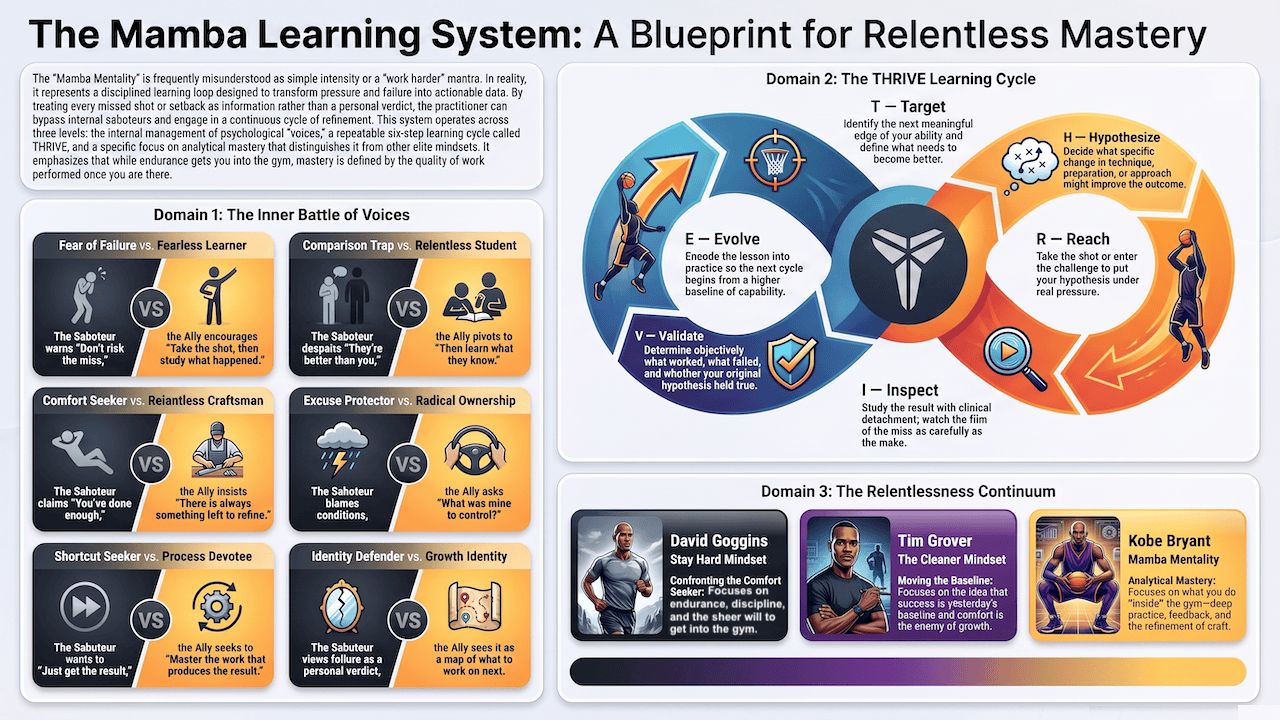
Other Quote Cards
We all have self-doubt. You don’t deny it, but you also don’t capitulate to it.”

“There’s a conversation that’s happening inside her head….”

“My brain, it cannot process failure. It will not process failure…”

“I want to see if maybe I’m not good enough today…”

“The reality is it’s all one thing… because it all comes from within.”

“The greatest fear that we face is ourselves…”

“What am I going to do? What can I control?”

“It’s not about being the best in the world right now…”
