

Does a Sikh Leadership Code “make” a leader truly trustworthy? For Sikhs, the answer is both spiritual and practical. Embedded in the Rehat Maryada is the Sikh Code of Conduct. More than a religious rulebook, this living guide offers a compass for navigating power, integrity, courage, and compassion in business, government, or any position of responsibility.
As context, I am not Sikh. I’m writing as someone who has been learning from Sikh colleagues and from observing how Sikh values show up in leadership and daily life. This page reflects my attempt to understand those principles and how they resonate with broader questions of responsibility and integrity. It is not meant to define Sikh teachings. If anything here feels incomplete or inaccurate, I welcome correction.
The Rehat Maryada is not designed as a mechanism of enforcement or conformity. It does not attempt to regulate leadership through fear, penalty, or external surveillance. Instead, it assumes that ethical failure begins internally. It does this through ego, attachment, or distorted intent, and long before it appears as misconduct or abuse of power. In this sense, the Rehat functions less as a rule-book and more as a mirror.
This page explores how Sikh principles, drawn from centuries of lived wisdom and codified in the Rehat Maryada, offer a compelling framework for modern executive leadership. Whether you’re an entrepreneur, executive, community builder, or people leader, this is a reflection on what it means to lead with both a crown of dignity and a heart of seva.
What Is the Rehat Maryada?
The Sikh Rehat Maryada is the official code of conduct for Sikhs, developed collectively over centuries and formally adopted in 1945 by the Shiromani Gurdwara Parbandhak Committee (SGPC). It outlines:
- How a Sikh should live, serve, and relate to others
- Core practices like Naam Simran (remembrance), honest living, and seva (selfless service)
- Prohibitions that guard against ego, exploitation, and indulgence
While deeply rooted in faith, the Rehat also functions as a values-based leadership manual. It emphasizes moral clarity, humility, courage, and community-oriented decision-making.
Leadership Qualities Embedded in the Rehat
1. Nimrata (Humility)
Leadership in Sikh tradition begins with a humble spirit. A true leader listens before speaking, centers the sangat (collective), and rejects arrogance. This reflects modern servant leadership principles found in coaching, DEI, and team-building. In Sikh leadership, humility does not mean shrinking from authority; it means refusing to confuse authority with self-importance.
2. Seva (Selfless Service)
Power isn’t for privilege; it’s for responsibility. Executives who embody seva approach strategy, hiring, and conflict through the lens of service: “Who am I helping? Who am I lifting?”
3. Niyam (Discipline)
The Rehat demands personal discipline: consistent remembrance of Waheguru, daily reflection, and alignment of action with intent. Leaders who live with niyam model consistency, reliability, and self-mastery.
4. Chardi Kala (Resilient Optimism)
Even amid setbacks or injustice, Sikh leadership calls for a fearless, forward-looking spirit. In the boardroom, this manifests as emotional resilience, long-term vision, and steady courage.
5. Justice with Compassion
Guru Nanak taught: “Realization of Truth is higher than all else. Higher still is truthful living.” Sikh leadership doesn’t flinch from accountability, but it tempers truth with compassion. This balance reflects the Sant-Sipahi ideal — not a title one claims, but a discipline of holding moral courage and inner restraint at the same time, especially when justice carries personal or professional cost.
Applying the Rehat in Business and Executive Life
Ethical Decision-Making
The Rehat Maryada encourages rejecting unjust profits, favoritism, and ego-driven actions. In business, this aligns with stakeholder capitalism and ethics-first strategy. One IIM Bangalore study even outlined how Sikh ethics offer an indigenous model of moral corporate governance.
Inclusive Leadership
The Rehat emphasizes the oneness of humanity (Ik Onkar) and equality across caste, class, and gender. Leaders inspired by this build inclusive teams, empower marginalized voices, and dismantle structural inequity.
Reputation Through Conduct
In Sikh tradition, leadership isn’t bestowed by title. It’s earned through conduct (rehat > raaj). This shifts the focus from performance optics to consistent values-driven behavior.
Inner Leadership: Saboteurs, Allies, and the Sikh Inner Landscape
In leadership contexts, these five thieves rarely appear as obvious moral failures. More often, they surface as distorted strengths: ambition sliding into greed, conviction hardening into ego, loyalty becoming attachment, urgency becoming anger, or desire overtaking discernment. The Rehat treats these not as sins to shame, but as inner conditions that must be recognized before they are allowed to govern decisions.
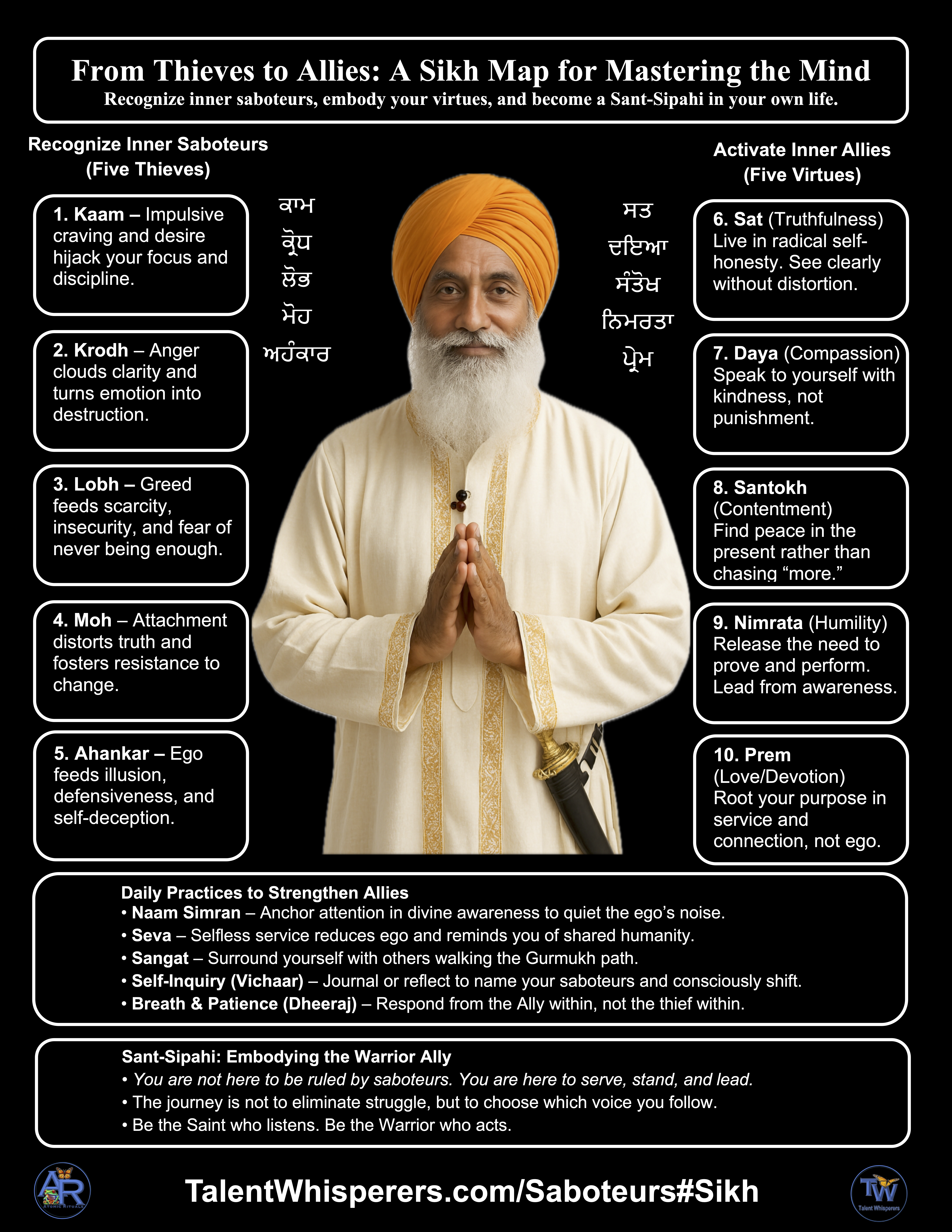
Modern neuroscience and coaching echo Sikh insights: we are governed not only by external pressures but by internal voices: saboteurs and allies. The five “thieves” (lust, anger, greed, attachment, ego) mirror internal saboteurs. The antidotes: contentment, compassion, generosity, detachment, and humility reflect the inner allies.
This dynamic is explored in:
- From Thieves to Allies: A Sikh Map for Mastering the Mind (Talent Whisperers Infographic)
Visual guide exploring the five inner “thieves” and five balancing virtues, reflecting saboteur and ally dynamics in Sikh teachings. - A Next-Level Strength: A Sikh Perspective (Chardi Kala)
An in-depth look at Chardi Kala as a force for transcendent optimism, leadership endurance, and emotional resilience. - Sikh Leadership Reflections from the Inside Out (Inner Voice Practices)
How Sikh virtues transform internal saboteurs.
Sikh Leadership in the World: From Langar Halls to Boardrooms
Sikh leaders across industries, from nonprofits to fintech, often bring:
- A calm refusal to exploit others
- A bias for inclusive decisions
- A practice of daily grounding in meaning and mission
Whether participating in SikhLEAD or serving langar on weekends, they model the fusion of spiritual depth and strategic excellence.
The Rehat as a Modern Leadership Compass
You don’t need to memorize every detail of the Rehat Maryada to live by its spirit:
- Lead with humility
- Make decisions through the lens of seva
- Seek justice without ego
- Commit to self-discipline as a form of service
- Let your presence uplift the collective
In a time when leadership trust is fragile, the Sikh code doesn’t just offer tradition. It offers transformation. In environments where power often moves faster than reflection, the Sikh code of conduct offers something increasingly rare: a discipline that scales inwardly before it scales outwardly.
See Also:
- A Next Level Strength: A Sikh Perspective (Talent Whisperers).
Explores how Sikh teachings illuminate a deeper strength that transcends ego and adversity, grounded in the ideal of Chardi Kala. - Co-Active Coaching and Sikh Wisdom (Talent Whisperers).
A guide for coaches and clients exploring intersections between Sikh beliefs and coaching principles like wholeness, presence, and transformation. - Sikh Wisdom for Healing and Resilience (Talent Whisperers).
Offers a gentle path for navigating challenge, burnout, and personal struggle through Sikh perspectives on sound, rest, and self-compassion. - From Thieves to Allies: A Sikh Map for Mastering the Mind (Talent Whisperers.
In Sikh philosophy, the battle between inner voices, those that empower us and those that hinder us, is deeply explored through spiritual teachings, historical narratives, and meditative practices. The Sikh perspective offers a profound lens on recognizing and transforming the saboteurs within, aligning one’s inner voice with truth, courage, and divine connection. - The Divine Rabab (Human Transformation).
Explores the notion that Sikh belief offers a profound understanding of the relationship between humanity and the Divine through the metaphor of The Musician, the Song, and the Divine Rabab. Music holds a sacred place in Sikhism, with Gurbani Kirtan (devotional singing) being central to spiritual practice. This metaphor explores the interplay between the individual, the divine, and the harmony that results when one aligns with divine wisdom. - Sikh Leadership Resources
Programs, papers, and reflections for Sikh professionals across roles and industries. - Sikh Decision Authority in Practice
Sikh decision authority reframes leadership not as control or entitlement, but as disciplined responsibility grounded in truth, humility, and collective conscience. This page explores how Sikh leadership approaches decision-making in practice, especially under pressure, uncertainty, and moral complexity. - Theorising Business Ethics Through a Sikh Lens
A scholarly exploration of Sikh values in corporate ethics. - City Sikhs (UK)
Professional network building Sikh leadership visibility and community. - Basics of Sikhi
Learn the deeper principles behind Sikh conduct and character.