

Exploring Sikh ego and humility in life and leadership as one interpretation among many, inviting reflection, dialogue, and discernment.
I want to acknowledge that I am not Sikh. I’m writing as someone who has been deeply moved by Sikh values and who is still learning. What follows is not an attempt to define Sikh teachings, but to reflect on how these ideas have resonated with me—especially the way many Sikhs live their principles consistently across personal, spiritual, and professional life. That integration has challenged me to rethink the separation I was taught to maintain between inner values and outer roles. If anything here feels misframed or incomplete, I welcome correction.
An Opening Acknowledgment
This page emerged in response to a thoughtful thoughtful and helpful critique. It is here taken as a gift.
The feedback was clear and direct: that while Sikh perspectives on equality, Akal Purakh, and service were present, humility, ego, and hubris were not sufficiently centered. It also noted that Sikh leadership, both recent and historical, has at times struggled here.
That observation deserves attention rather than defense. The observation itself is a gift. While Sikh tradition values humility, ego and hubris have been topics of many discussions, they had not yet been captured in writing within the Talent Whisperers’ ecosystem and writing.
At the same time, this page does not claim to resolve that tension or present a definitive Sikh position. Sikh tradition resists singular interpretation by design. Gurbani itself is dialogical, poetic, paradoxical, and multi-voiced. What follows is one interpretive lens, shaped by lived experience, study, and reflection, offered in the spirit of inquiry rather than authority.
To listen to these concepts and other Sikh Leadership perspectives, see also the evolving podcast series:
Humility as a Core, Not a Footnote
Within Sikh thought, humility is not an accessory virtue. It sits alongside truth, equality, and remembrance as a foundational orientation toward life.
Yet humility in Sikhism can be misunderstood. It is not self-erasure, nor is it is not submission to injustice. It is not silence in the face of harm. Also, it is not a performance of modesty.
Humility, as it appears again and again in Sikh teachings, is relational. It is the posture that arises when one recognizes that the self is not the source, not the center, and not the measure of all things. It is grounded in remembrance that whatever capacity one holds flows through, not from, the individual.
This can make humility unstable when paired with power. when paired with power.
Leadership magnifies whatever is already present. If humility is practiced only privately, leadership will expose that gap. If ego is unexamined, authority gives it amplification rather than correction.
Ego in Sikh Thought Is Subtle, Not Crude
Sikh teachings on ego are often translated or summarized as warnings against arrogance or pride. That framing can feel incomplete.
Ego in Sikh thought is not merely inflated self-importance. It is identification itself. It is the quiet belief that “I” am the doer, the knower, the rightful owner of outcomes. Ego is not always loud. It often appears as certainty, righteousness, or moral confidence.
This is why ego can be especially dangerous when paired with good intentions.
A leader may sincerely believe they are serving. A movement may genuinely seek justice. A tradition may hold real wisdom. And yet, when ego subtly replaces service, humility collapses into self-justification.
In that collapse, critique feels like attack. Questioning feels like betrayal. Reflection gives way to defense.
Hubris does not always announce itself. It arrives wearing the language of purpose. The sections that follow explore how Sikh tradition speaks about this distortion, and how leadership exposes it under real conditions of power.
Ahankar and Nimrata: Ego and Humility in Sikh Practice
Sikh teachings may sometimes speak of eradicating ego and attaining liberation, but this exploration stays closer to how ego and humility behave in lived life and leadership, where intentions are sincere and certainty is tempting.
In Sikh thought, ego is not treated as a personality flaw so much as a spiritual distortion. Ahankar refers to the subtle sense of self-importance that arises when one begins to believe they are the source of their actions, insights, or successes. It can attach itself to wealth, intelligence, devotion, or even service, quietly reinforcing separation rather than connection.
Against this, Sikh tradition places Nimrata, humility, not as self-negation but as right orientation. Humility emerges when one recognizes the Divine presence in all beings and understands the self as a participant in, not owner of, life’s unfolding. This recognition softens certainty and loosens the grip of “I” and “mine.”
Practices such as Sewa and Simran are not meant to perform humility, but to cultivate it. Serving in the Langar or cleaning a gurdwara is less about the act itself and more about what it erodes. Over time, service interrupts ego’s narrative of superiority and replaces it with relationship. Likewise, remembrance through Simran reorients attention away from self-authorship toward alignment with Hukam, the larger flow of life.
Sikh teachings sometimes describe humility as becoming “the dust of the feet of all.” Read literally, this can sound extreme. Read relationally, it points to a posture in which dignity is no longer defended through comparison, and honor arises from service rather than status. For leaders, this is not weakness. It is a safeguard against hubris.
Leadership as a Spiritual Stress Test on Sikh Ego and Humility
Sikh leadership, like all leadership, operates under pressure. Visibility, authority, and responsibility create constant tests of orientation.
The challenge is not whether Sikh leaders know the language of humility. It is whether humility survives contact with power.
History shows moments of profound courage, sacrifice, and service within Sikh leadership. It also shows moments where identity hardened, authority calcified, and dissent was resisted rather than welcomed.
To acknowledge this is not to diminish Sikh tradition. It is to take it seriously.
If Sikh leadership is to reflect Sikh wisdom, humility cannot be assumed as inherited. It must be practiced under conditions that actively resist it.
Interpretive Humility as Practice
This page itself must be subject to the same discipline it explores.
What is offered here is not a claim about what Sikhism definitively teaches. It is an exploration of how Sikh ego and humility might be understood, lived, and challenged in contemporary life and leadership.
Other interpretations exist. Some may emphasize discipline. Others may emphasize obedience, surrender, or collective identity. Still others may center resistance, sovereignty, or resilience.
Those perspectives are not wrong by default. They are part of a living tradition.
Interpretive humility asks a different question. Not “Which view is correct?” but “What does this view reveal, and what might it obscure?”
When Service Becomes Identity
One of the most delicate transitions in leadership occurs when service becomes identity.
At first, service is an act. Then it becomes a role. Eventually, it risks becoming self-definition.
When that shift happens, humility is threatened. Feedback feels destabilizing. Letting go feels like loss. Stepping aside feels like erasure.
Sikh wisdom repeatedly points toward service without attachment. Toward action without ownership. Toward leadership without self-congratulation.
This is not an abstract ideal. It is a daily practice, and one that leadership makes harder rather than easier.
This stance echoes a broader theme explored elsewhere through the metaphor of the blind men and the elephant, where Sikh thought emphasizes that humility arises not from denying truth, but from recognizing how easily ego mistakes proximity for completeness.
An Invitation, Not a Verdict
This page does not seek to diagnose Sikh leadership, past or present. It does not aim to rank failures or prescribe corrections.
Instead, it invites a different stance.
- Sit with the tension between humility and authority.
- Notice where ego quietly replaces service.
- Ask how leadership can remain porous rather than rigid.
- Recognize that even sincere devotion requires ongoing self-interrogation.
If Sikh wisdom has anything enduring to offer leadership, it is not immunity from failure. It is the courage to remain teachable.
That courage begins with humility, not as a claim, but as a practice continually tested in life and leadership.
See Also
A brief transition into further exploration
The reflections above are not meant to stand alone. They sit within a wider, ongoing conversation across Sikh thought, leadership practice, and ethical inquiry. For readers who wish to explore adjacent perspectives, foundations, and tensions, the following resources offer useful points of entry.
External Resources related to Sikh Ego and Humility
Nimrata (Humility in Sikh Ethics)
An overview of humility as a core Sikh virtue, emphasizing relational posture, restraint, and openness rather than submission or self-erasure.
Haumai (Egoism in Sikh Thought)
A foundational explanation of haumai in Sikh philosophy, describing ego as self-centered identification that subtly distorts perception, intention, and service.
Hankaar (Pride as a Moral Challenge)
An exploration of hankaar, often translated as pride or arrogance, and its role among the Five Thieves that undermine humility, discernment, and ethical action.
Talent, Arrogance, and Modesty (SikhNet)
A reflective essay examining how talent and competence can quietly slide into arrogance, and how humility functions as a stabilizing force in Sikh life.
Theorising Business Ethics Through a Sikh Lens (Journal of Economics, Management and Religion)
An academic examination of Sikh ethical principles such as humility, honest labor, service, and moral restraint, applied to contemporary leadership, governance, and organizational life.
Internal Resources
Sikh Leadership Resources (Talent Whisperers)
A curated collection of essays and reflections examining Sikh leadership, service, responsibility, and ethical tension across historical and modern contexts.
Sikh Leadership and the Code of Conduct (Talent Whisperers)
A reflection on how the Sikh Rehat Maryada (Code of Conduct) offers a framework for integrity, courage, and compassion in executive roles.
A Next Level Strength: A Sikh Perspective (Talent Whisperers).
An in-depth look at Chardi Kala as a force for transcendent optimism, leadership endurance, and emotional resilience.
The Turban and the Title (Talent Whisperers).
Leadership as sacred responsibility in visible roles. The Turban and Title analogy is explored here. In Sikh tradition, wearing a turban is not merely a religious symbol. It is a public declaration of identity, honor, and accountability. To tie one’s turban each day is to visibly affirm one’s values. It signals to the world: this is who I am, this is what I stand for.
Sikh Wisdom for Weathering Storms (Talent Whisperers).
This page explores how Sikh teachings—Chardi Kala (ever-rising spirit), Seva (selfless service), Naam Simran (remembrance), and the Five Virtues—can inform each core section of the Weathering Storms navigational framework. For Sikh professionals, these principles are not abstract ideals. They are daily disciplines—anchoring decisions, stabilizing teams, and elevating leadership through grace and grit alike.
Atomic Rituals as Seen through a Sikh Lens (Atomic Rituals).
In Sikh tradition, transformation is not a sudden overhaul but a disciplined, conscious evolution. Sikhism teaches that divinity lies in the everyday—in actions repeated with mindfulness, in service done without ego, and in resilience shown during challenge. These same values echo powerfully in the framework of Atomic Rituals.
From Thieves to Allies: A Sikh Map for Mastering the Mind (Talent Whisperers).
In Sikh philosophy, the battle between inner voices—those that empower us and those that hinder us—is deeply explored through spiritual teachings, historical narratives, and meditative practices. The Sikh perspective offers a profound lens on recognizing and transforming the saboteurs within, aligning one’s inner voice with truth, courage, and divine connection.
From Thieves to Allies: A Sikh Map for Mastering the Mind (Talent Whisperers Infographic).
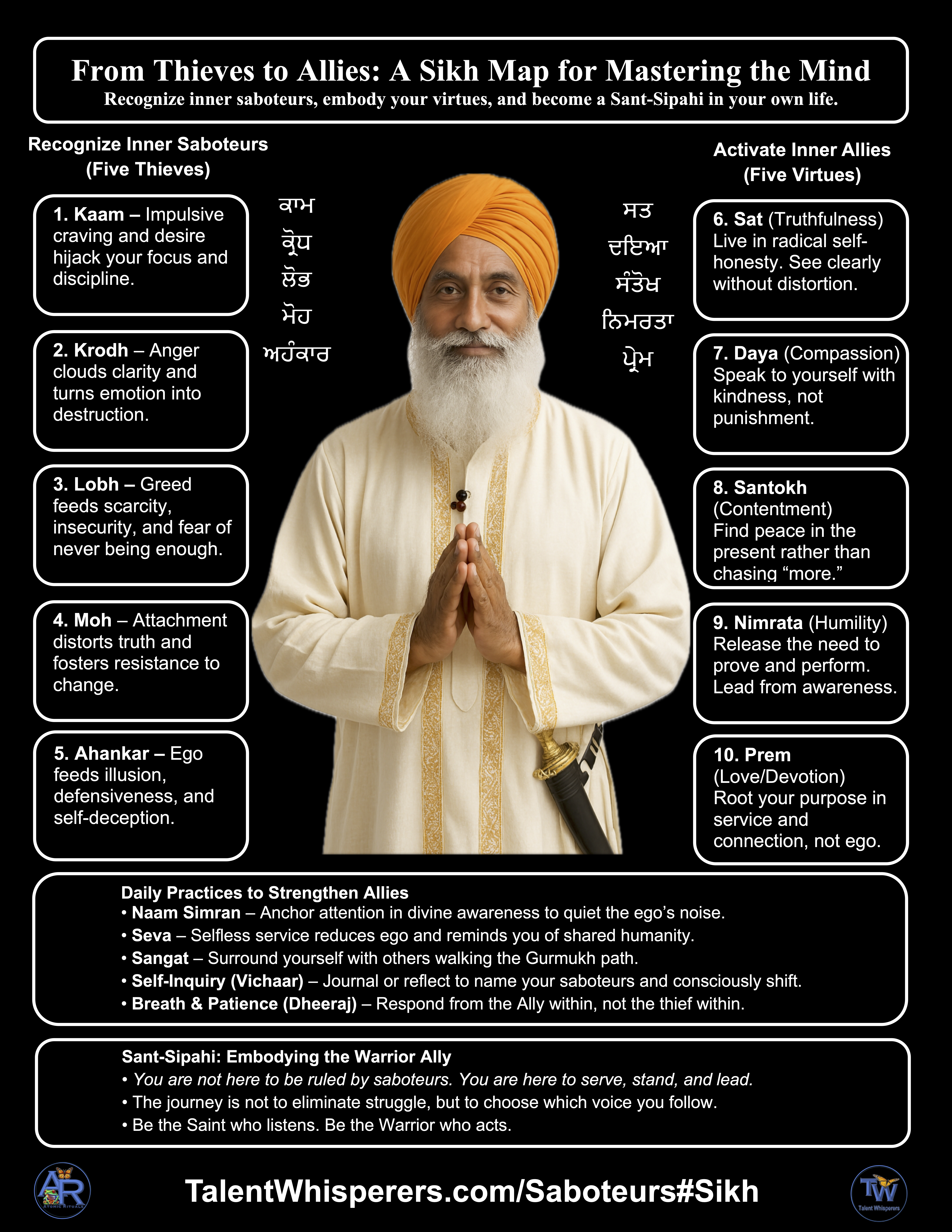
Visual guide exploring the five inner “thieves” and five balancing virtues, reflecting saboteur and ally dynamics in Sikh teachings
God as an Elephant: Sikh Perspectives on Partial Truth and Humility (Human Transformation)
An exploration of Sikh views on pluralism, Ik Onkar, Miri Piri, and humility through the metaphor of the blind men and the elephant, emphasizing how partial perspectives invite openness rather than certainty.

In Sikh thought, truth is understood as vast, living, and beyond any single human grasp. While Sikhism affirms Ik Onkar, the Oneness of Reality, it also recognizes that people encounter and understand that Oneness through different life paths, experiences, and perspectives. This diversity of understanding is not a weakness of the tradition. It is one of its strengths.
The metaphor often described as “God as an elephant” captures this insight well. Each person touches a different part of the same reality, perceiving something real but partial. Sikh wisdom affirms insight, while simultaneously cautioning against the ego that arises when perspective is mistaken for possession of truth.
This humility is central to Sikh teaching. The Gurus repeatedly warned against haumai, the subtle “I know” that hardens insight into certainty and curiosity into rigidity. From a Sikh perspective, humility is not passive tolerance of difference, but an active openness to learning, paired with vigilance toward one’s own convictions.
Multiple Perspectives and the Oneness of Humanity
Guru Nanak taught that no caste, gender, culture, or belief system holds a monopoly on truth. This is reflected powerfully in the Guru Granth Sahib itself, which includes writings from saints across faith traditions, regions, and social backgrounds. Sikhism does not merely allow multiple perspectives; it honors them as reflections of the same divine light, seen through different eyes.
This approach invites leaders and communities to move beyond debate toward listening, not to dilute truth, but to expand one’s understanding of it.
Miri-Piri: Holding Complexity Without Fragmentation
The Sikh principle of Miri-Piri, the inseparability of spiritual grounding and worldly responsibility, reinforces this plural vision. Devotional, ethical, political, experiential, and intellectual ways of seeing are not in conflict. They are complementary lenses that, when held together, form a more complete understanding.
Within Sikh leadership, this also affirms the authority of gender-diverse and role-diverse perspectives. Women, householders, activists, executives, elders, and seekers each encounter truth through different responsibilities and realities. Sikhism affirms that these perspectives deepen collective wisdom rather than threaten it.
Shared Truth Through Reflection and Sangat
Sikh practice is grounded in Naam Simran (remembrance), Seva (service), and Sangat (community), practices that continually soften certainty and renew openness. Truth is not discovered once and defended forever; it is approached, tested, refined, and lived through dialogue and shared experience.
In this sense, Sikh wisdom resonates with the idea that no one touches the whole elephant alone. What matters is not winning arguments, but remaining curious, grounded, and committed to the collective journey toward greater completeness, nuance, and compassion.