

Sikh Leadership Resource, Sarab da Bhalla in Practice is a guide on how to ensure organizational decisions contribute to the collective flourishing of every subgroup.. What does it mean to lead like a Sikh? Across the globe, Sikh professionals, executives, and entrepreneurs are drawing on timeless spiritual principles: service (seva), justice (nyaya), humility (nimrata), and resilience (chardi kala). These shape a distinct and values-driven approach to leadership.
As context, I am not Sikh. This resource page grew out of my own learning journey and my desire to understand Sikh leadership more deeply. It is not meant to define Sikh teachings, but to gather materials that have helped me appreciate how Sikh values show up in life, work, and community. If anything here feels incomplete or misframed, I welcome correction.
This collaborative resource page curates some of the most insightful tools, articles, and programs available for Sikh leaders. These resources are from academic research to professional mentorship to purpose-driven retreats. We also include original pages from TalentWhisperers that explore Sikh inner voices, saboteurs, and the journey of transformation.
Sikh leadership offers a timely and powerful model for today’s complex world. It is one rooted not in authority, but in service, courage, and the unwavering commitment to uplift all (Sarbat da Bhalla). In an era defined by rapid change, ethical strain, and identity‑based challenges, Sikh principles such as Seva, Chardi Kala, Miri‑Piri, and Bibek provide a distinct blueprint for leading with integrity, resilience, and collective responsibility. What sets Sikh leadership apart is its fusion of spiritual grounding with fully engaged worldly action: the householder’s path, the saint‑soldier ideal, and the belief that every role is an opportunity to serve. This resource page attempts to brings together the best of that tradition found in research, programs, case studies, and Talent Whisperers explorations. This done to support modern leaders who are curious and open to continual learning on how to lead with purpose, navigate adversity with grace, and build communities and organizations aligned with timeless Sikh values.
How to Use This Resource
This page is designed to meet you where you are in your leadership journey. If you’re new to Sikh leadership, begin with Principles & Ethics to ground yourself in the core values that shape Sikh decision‑making. Mid‑career professionals or organizational leaders may want to explore Programs, Case Studies, and Modern Biographies to see how these principles translate into real‑world impact. Coaches, mentors, and those guiding others can dive into the Talent Whisperers explorations, which offer applied frameworks, inner‑voice work, and Sikh‑aligned approaches to transformation.
ਸਰਬੱਤ ਦਾ ਭਲਾ — ਸਭ ਦੇ ਉਤ्थਾਨ ਲਈ ਸੇਵਾ ਅਤੇ ਨੇਤ੍ਰਿਤਵ
Sarbat da Bhalla — leadership and service for the uplift of all
Dedication

This resource is dedicated to Harman Singh, CFO at Together Labs, whose journey as a turban‑wearing Sikh leader has illuminated how deeply Sikh principles align with the belief that the way we do one thing is the way we do everything. Through our coaching partnership that spans many conversations and exchanges over the last couple of years, we continue to uncover the profound synergies between Sikh identity and exceptional leadership.
Note: See also a list of other Talent Whisperer’s perspectives on leadership.
Table of Contents
- Sikh Leadership Framework: Seven Core Pillars
- Sikh Leadership Principles & Ethics
- Sikh Leadership Development Programs
- Sikh Professional Networks & Support
- Related Talent Whisperers Explorations
- Case Studies and Modern Biographies
- Networking and Peer Mentorship Features
- Inclusion of Diverse Perspectives
- Sikh Perspectives: God as an Elephant
- Measurable Impact and Research
- How Sikh Leadership Shows Up in Modern Challenges
- Glossary of Sikh Leadership Terms
- Sikh Wisdom: Frequently Asked Questions (faq)
- Appendix: Talent Whisperers Through a Sikh Lens
- See Also: External References
If you know a resource that belongs here, please share it so this page can continue to grow with the community.
To listen to some of these Sikh Leadership perspectives, see also the evolving podcast series:
Sikh Leadership Framework: Seven Core Pillars

- Identity as Responsibility Leadership begins with owning who you are and the values you visibly represent.
- Seva as Leadership Service is not an act but a posture – leading by uplifting others first.
- Chardi Kala as Resilience The discipline of rising with courage, grace, and optimism even in adversity.
- Miri‑Piri as Decision‑Making Balancing worldly effectiveness with spiritual grounding in every choice.
- Sangat as Collective Intelligence Wisdom emerges through community, collaboration, and shared purpose.
- Bibek as Discernment Seeing clearly – choosing truth over ego, long‑term good over short‑term gain.
- Ik Onkar as Oneness in Action Acting from the understanding that all beings are interconnected and worthy of dignity.
Sikh Leadership Principles & Ethics
1. Theorising Business Ethics Through a Sikh Lens (IDEAS)
An academic paper exploring how Sikh teachings (Gurmat) influence stakeholder-centered business ethics and moral leadership.
2. Ethics and Business: Evidence from Sikh Religion (IIM Bangalore)
This research paper examines how Sikh scriptural principles shape ethical decisions in commerce, management, and governance.
3. Sikh Leadership and the Code of Conduct (TalentWhisperers)
A reflection on how the Sikh Rehat Maryada (Code of Conduct) offers a framework for integrity, courage, and compassion in executive roles.

Sikh Leadership Development Programs
4. SikhLEAD (SALDEF)
A structured program for emerging Sikh American leaders, combining mentorship, public service, and professional training.
5. Sidak Leadership Program (SikhRI)
A deep dive into Sikh history, Gurbani, and applied ethics. It is best suited for mid-career professionals seeking purpose and clarity.
6. Sikhs Without Borders
Global service-based programs combining Sikh identity and social entrepreneurship for the next generation of leaders.
Sikh Professional Networks & Support
See also Networking and Peer Mentorship Features below.
7. City Sikhs (UK)
A leading network for British Sikh professionals offering advocacy, mentorship, and community for Sikh leaders.
8. Basics of Sikhi (Everythings13)
Educational videos, talks, and courses that provide a strong philosophical foundation for Sikh values in life and leadership.
Related Talent Whisperers Explorations
TalentWhisperers.com is a site dedicated to help in the areas of leadership and leadership coaching. Several pages and sections within documents have been dedicated at taking a closer look at various things though the lens of Sikh belief and traditions. HumanTransformation.com and AtomicRituals.com are related sister sites.
9. A Next Level Strength: A Sikh Perspective (Talent Whisperers).
An in-depth look at Chardi Kala as a force for transcendent optimism, leadership endurance, and emotional resilience.

10. The Turban and the Title (Talent Whisperers).
Leadership as sacred responsibility in visible roles. The Turban and Title analogy is explored here. In Sikh tradition, wearing a turban is not merely a religious symbol. It is a public declaration of identity, honor, and accountability. To tie one’s turban each day is to visibly affirm one’s values. It signals to the world: this is who I am, this is what I stand for.

11. Sikh Decision Authority in Practice (Talent Whisperers)
Sikh decision authority reframes leadership not as control or entitlement, but as disciplined responsibility grounded in truth, humility, and collective conscience. This page explores how Sikh leadership approaches decision-making in practice, especially under pressure, uncertainty, and moral complexity.

12. Sikh Wisdom for Weathering Storms (Talent Whisperers).
This page explores how Sikh teachings—Chardi Kala (ever-rising spirit), Seva (selfless service), Naam Simran (remembrance), and the Five Virtues—can inform each core section of the Weathering Storms navigational framework. For Sikh professionals, these principles are not abstract ideals. They are daily disciplines—anchoring decisions, stabilizing teams, and elevating leadership through grace and grit alike.

13. Atomic Rituals as Seen through a Sikh Lens (Atomic Rituals).
In Sikh tradition, transformation is not a sudden overhaul but a disciplined, conscious evolution. Sikhism teaches that divinity lies in the everyday—in actions repeated with mindfulness, in service done without ego, and in resilience shown during challenge. These same values echo powerfully in the framework of Atomic Rituals.

14. From Thieves to Allies: A Sikh Map for Mastering the Mind (Talent Whisperers).
In Sikh philosophy, the battle between inner voices—those that empower us and those that hinder us—is deeply explored through spiritual teachings, historical narratives, and meditative practices. The Sikh perspective offers a profound lens on recognizing and transforming the saboteurs within, aligning one’s inner voice with truth, courage, and divine connection.

15. From Thieves to Allies: A Sikh Map for Mastering the Mind (Talent Whisperers Infographic)
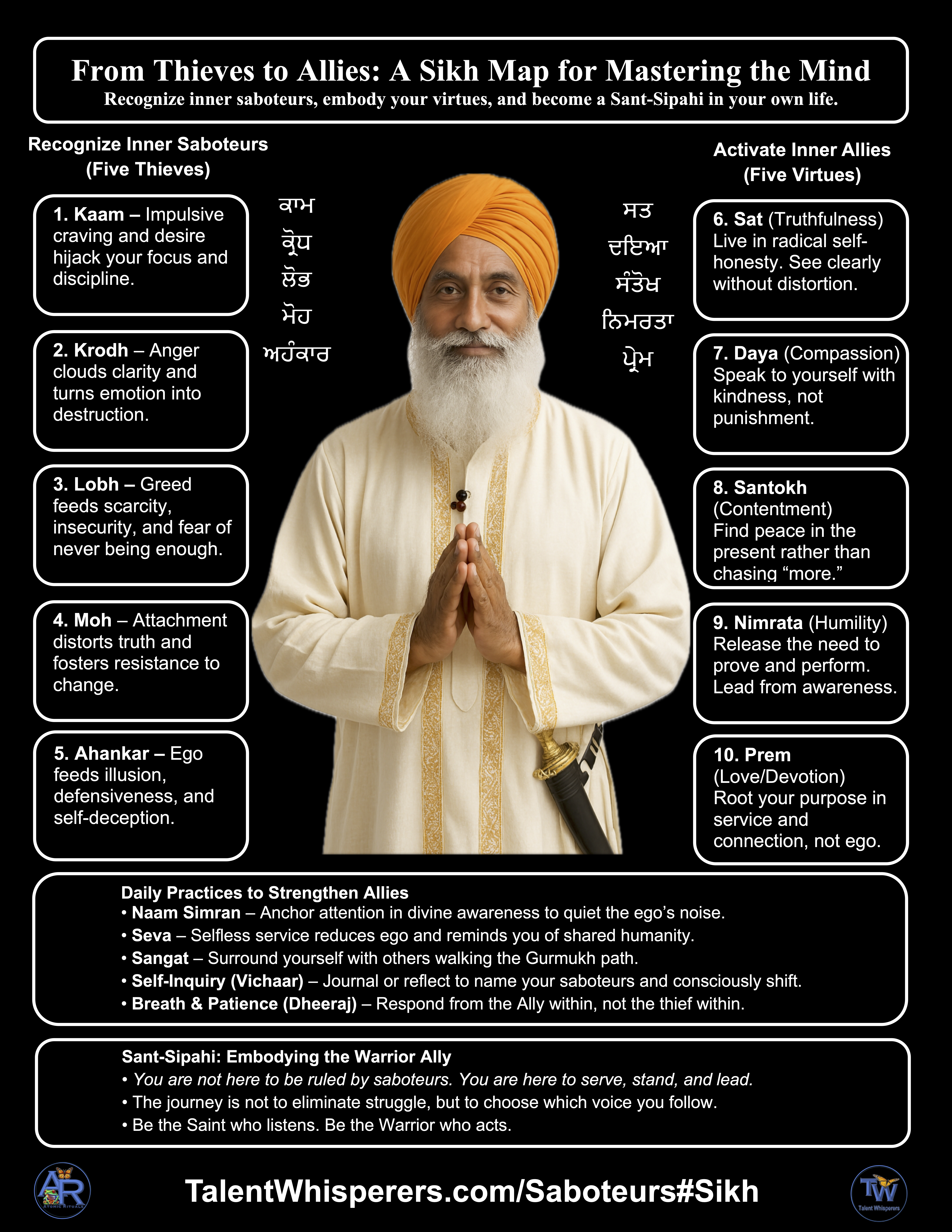
Visual guide exploring the five inner “thieves” and five balancing virtues, reflecting saboteur and ally dynamics in Sikh teachings.

16. Learned Resilience in the Eyes of a Sikh (Talent Whisperers).
Sikh resilience is a powerful human trait. esilience is a powerful human trait. For Sikhs, this quality is deeply woven into their spiritual and historical fabric. It is not merely about enduring hardship. Instead, Sikh resilience involves the active cultivation of spirit. This profound strength stems from core principles. A unique philosophy called Chardi Kala expresses this strength.

17. The Individual Journey Through the Lens of Sikh Belief (Human Transformation).
In Sikhism, the journey of an individual is deeply spiritual and purpose-driven, rooted in the recognition of divine presence within oneself and the universe. This journey is not solitary; it is both personal and universal, reflecting Sikhism’s emphasis on the interconnectedness of all life through the concept of Ik Onkar (One Creator). Sikh teachings encourage us to explore this path through self-reflection, service, and alignment with divine will.

18. The Collective Journey in Sikh Belief (Human Transformation).
In Sikhism, the concept of a collective journey is deeply interwoven with the principles of community and unity. Known as Sangat (holy congregation), this idea emphasizes that spiritual growth is not just an individual pursuit but a shared experience. The collective journey highlights how coming together with others strengthens faith, fosters compassion, and brings us closer to the divine.

19. Sikh Wisdom for Healing and Resilience (Talent Whisperers).
Offers a gentle path for navigating challenge, burnout, and personal struggle through Sikh perspectives on sound, rest, and self-compassion.

20. The Divine Rabab (Human Transformation).
Explores the notion that Sikh belief offers a profound understanding of the relationship between humanity and the Divine through the metaphor of The Musician, the Song, and the Divine Rabab. Music holds a sacred place in Sikhism, with Gurbani Kirtan (devotional singing) being central to spiritual practice. This metaphor explores the interplay between the individual, the divine, and the harmony that results when one aligns with divine wisdom.

21. Talent Whisperers Through a Sikh Lens (Talent Whisperers).
Explores the Essence of a Talent Whisperer in the context of Sikh belief. The Whisper, the Sword, and the Vow — different expressions of the same sacred duty: to see the divine in others, and to help them see it in themselves.

22. Co-Active Coaching and Sikh Wisdom (Talent Whisperers).
A guide for coaches and clients exploring intersections between Sikh beliefs and coaching principles like wholeness, presence, and transformation.

This evolving resource is meant to support Sikh leaders at every stage — whether you’re just beginning your journey, seeking to lead from your values, or mentoring the next generation. Want to suggest a resource? Let us know.
23. Key Organizations & Programs
Key Organizations & Programs:
- SALDEF (Sikh American Legal Defense and Education Fund): Offers leadership development, innovation fellowships for entrepreneurs, and advocacy/research to empower Sikh Americans in civic life.
- Sikh Coalition: Provides the Jyot Curriculum for youth social justice leadership, anti-bullying resources, and the Ambassador program to connect communities with resources.
- United Sikh Movement (USM): Supports Sikh Student Associations (SSAs) with event ideas, planning guides, and leadership retreats, plus professional development.
- Sikh Research Institute (SikhRI): Offers the Sidakadult learning program focusing on Sikh culture, history, and values-based leadership development.
SikhRI connects people with the teachings of Sikhi and strengthens the bonds of the Sikh community around the world by offering courses and seminars in a variety of mediums In an ideal world, happy and tolerant people live together in peace. They are genuinely enthused to share what they know and freely exchange knowledge on topics they are passionate about. Their lives are driven by values that are dear to them and are full of meaning it. Enlightenment and happiness are ubiquitous.
This is the world that we strive to create by:
1. Making Sikh education accessible to anyone.
2. Helping more people to understand the principles of Sikhi.
3. Presenting Gurbani the way it is.
Types of Resources Available:
- Youth Leadership: Programs like SALDEF’s LDP and Sikh Coalition’s Jyot train young Sikhs in advocacy, community building, and civic engagement.
- Community Engagement: Tools for Gurdwaras (board governance), open houses, and anti-hate/bias training.
- Skill Development: Workshops on public speaking, project management, conflict resolution, and applying Sikh values (like seva, nimrata) to leadership.
- Educational Materials: Brochures, reporter’s guides, and online courses (e.g., HarvardX) on Sikhism, history, and faith.
24. Case Studies and Modern Biographies
Ajay Banga: Leading Global Finance with Inclusivity
As the first person of South Asian descent to lead the World Bank, Ajay Banga embodies Sarbat da Bhalla, which means the well-being of all. He utilizes a “Saint-Soldier” mindset to tackle global poverty while maintaining fierce operational excellence in high-pressure environments. Consequently, his leadership proves that spiritual grounding can stabilize massive international organizations during volatile economic shifts.
Sukhinder Singh Cassidy: Tech Innovation and the Householder’s Path
The current CEO of Xero, Sukhinder Singh Cassidy, illustrates the Grihastha path by balancing elite technology leadership with family and community. She founded theBoardlist to improve corporate diversity, directly applying Sikh ideals of equality and selfless service, or Seva. Her career demonstrates that spiritual depth is cultivated within everyday professional responsibility rather than apart from it.
Ratanjit Singh: The Oneness Paradigm in Modern Business
Ratanjit Singh built a multi-million dollar empire by strictly adhering to the foundational concept of Ik Onkar, or Oneness. He advocates for a “stress-free” business model where success comes from nurturing the divine spark in others. This approach mirrors the Sikh belief that honest labor and divinity are found in the repetition of everyday actions.
Satjiv S. Chahil: Marketing with a Spiritual Anchor
Satjiv Singh Chahil held senior roles at Apple and IBM, often citing his heritage as a strategic advantage. His work in global marketing reflects the Miri-Piri balance, which integrates temporal power with deep spiritual grounding. Therefore, he shows that ethics and presence belong equally in corporate boardrooms and places of prayer.
Rani Sada Kaur: The Strategic Architect of Unity
Historically, Rani Sada Kaur serves as a primary case study for the “Kingmaker” archetype in Sikh leadership. She united disparate factions to build a lasting empire, demonstrating how resilience and strategic alliance foster collective flourishing. Her legacy remains a powerful example of Chardi Kala, or the discipline of maintaining an ever-rising spirit during adversity.
Sikh Wisdom and Leadership This video explores the evolution of leadership from “kings to kingmakers,” echoing the service-oriented archetypes found in Sikh tradition.
25. Networking and Peer Mentorship Features
A Directory of Sikh-Led Businesses and Forums for Ethical B2B Partnerships
Establishing a dedicated directory allows leaders to practice Kirat (honest labor) and Sarbat da Bhalla (the well-being of all) by reinvesting in a values-aligned ecosystem.
- The Sikh Directory: As the world’s largest comprehensive database of Sikh businesses, it connects buyers and sellers while stimulating community networking.
- Sikh a Business: A UK-based interactive platform that allows Sikh-owned businesses to showcase their work and connect with a global customer base.
- Networking of Sikhs (NOS): A platform designed specifically for B2B referrals, helping entrepreneurs grow through verified community links.
- Sikh Philosophy Network (SPN): A long‑standing, active discussion forum focused on Sikh thought, ethics, contemporary issues, and community leadership.
- Global Sikh Council Forum (GSC Forum): A global forum explicitly designed to connect Sikhs worldwide around Sikhi thought, community issues, and the future of Sikh leadership. Cited from search results: GSC hosts discussions on “Future of Sikhi & Sikhs,” community events, and leadership‑related topics.
- SikhSangat.com: A very active community forum with sections on Sikh history, culture, lifestyle, and contemporary issues. Cited from search results: SikhSangat hosts discussions on Sikh history, culture, and modern issues, with high engagement.
Mentorship Matching Portal for Professionals
Connecting young “seekers” with mid-career leaders fosters Sangat (transformative community) and ensures the transfer of Gurmat (divine wisdom).
- Sikhia Mentor Database: This online platform connects students and young professionals with mentors across various industries to eliminate barriers to success.
- Junior Sikh Coalition Mentorship: Provides high school and college students with intensive leadership training and direct access to professional advocates.
- Sidak Leadership Program: Offers a peer-mentorship environment where diverse backgrounds converge to learn effective, Guru-centered leadership.
Upcoming Events and Webinars
Engaging in collective learning helps leaders weather modern “storms” by aligning their inner voices with truth and resilience.
- Sikhs and the Changing World Conference (April 25, 2026): A deep dive into how Sikh leadership must adapt to global shifts in Cambridge.
- Nishaan 2026 Educational Leadership Conference: A specialized event in Davis, CA, focused on identity-driven leadership and preparing for future roles.
26. Inclusion of Diverse Perspectives
Sikh Women in Leadership: Leading with Daya and Nimrata
Gender equality is a core tenet of the Sikh faith, yet women often navigate unique societal expectations while leading. By embodying Daya (compassion) and Nimrata (humility), Sikh women demonstrate that leadership is not about domination but about service and empowerment.
- Kaur Life: This platform provides a space for Sikh women to share stories of leadership, identity, and the application of Gurmat in modern professional life.
- Sikh Feminist Research Institute (SFRI): An organization dedicated to revitalizing the Sikh tradition of gender equality through research and community education.
Navigating the Diaspora: Challenges of Visible Identity
Sikh leaders in the diaspora often face specific hurdles, such as unconscious bias or maintaining a visible identity in corporate roles. The Sant-Sipahi archetype helps these leaders maintain moral courage and resilience when facing external pressures.
- Sikh Coalition – Community Resources: Offers specific tools for addressing bias, hate crimes, and workplace discrimination to protect the dignity of all community members..
Inclusive Sangat: Supporting Minority Subgroups
True inclusion within the Sangat involves acknowledging the diverse backgrounds and perspectives of every individual. This approach supports a culture of dignity and reverence for all, ensuring that no voice is marginalized within the collective journey.
- United Sikh Movement (USM): Provides professional development and leadership retreats specifically designed to support diverse Sikh student associations and emerging leaders.
27. Sikh Perspectives: God as an Elephant (Human Transformation)
(A Metaphor for Humility, Diversity, and Evolving Understanding)

In Sikh thought, truth is understood as vast, living, and beyond any single human grasp. While Sikhism affirms Ik Onkar, the Oneness of Reality, it also recognizes that people encounter and understand that Oneness through different life paths, experiences, and perspectives. This diversity of understanding is not a weakness of the tradition. It is one of its strengths.
The metaphor often described as “God as an elephant” captures this insight well. Each person touches a different part of the same reality, perceiving something real but partial. Sikh wisdom affirms insight, while simultaneously cautioning against the ego that arises when perspective is mistaken for possession of truth.
This humility is central to Sikh teaching. The Gurus repeatedly warned against haumai, the subtle “I know” that hardens insight into certainty and curiosity into rigidity. From a Sikh perspective, humility is not passive tolerance of difference, but an active openness to learning, paired with vigilance toward one’s own convictions.
Multiple Perspectives and the Oneness of Humanity
Guru Nanak taught that no caste, gender, culture, or belief system holds a monopoly on truth. This is reflected powerfully in the Guru Granth Sahib itself, which includes writings from saints across faith traditions, regions, and social backgrounds. Sikhism does not merely allow multiple perspectives; it honors them as reflections of the same divine light, seen through different eyes.
This approach invites leaders and communities to move beyond debate toward listening, not to dilute truth, but to expand one’s understanding of it.
Miri-Piri: Holding Complexity Without Fragmentation
The Sikh principle of Miri-Piri, the inseparability of spiritual grounding and worldly responsibility, reinforces this plural vision. Devotional, ethical, political, experiential, and intellectual ways of seeing are not in conflict. They are complementary lenses that, when held together, form a more complete understanding.
Within Sikh leadership, this also affirms the authority of gender-diverse and role-diverse perspectives. Women, householders, activists, executives, elders, and seekers each encounter truth through different responsibilities and realities. Sikhism affirms that these perspectives deepen collective wisdom rather than threaten it.
Shared Truth Through Reflection and Sangat
Sikh practice is grounded in Naam Simran (remembrance), Seva (service), and Sangat (community), practices that continually soften certainty and renew openness. Truth is not discovered once and defended forever; it is approached, tested, refined, and lived through dialogue and shared experience.
In this sense, Sikh wisdom resonates with the idea that no one touches the whole elephant alone. What matters is not winning arguments, but remaining curious, grounded, and committed to the collective journey toward greater completeness, nuance, and compassion.
Sikhism thus offers not only pluralism of views, but humility of stance, a reminder that ego often hides closest to conviction, and that leadership matures through openness, not certainty.
28. Measurable Impact and Research
The Financial ROI of Values-Based Leadership
Research consistently shows that ethical and values-based leadership models drive superior financial indicators. A 2025 study found that ethical leadership significantly improves Return on Assets (ROA) and market valuation, as measured by Tobin’s Q. Furthermore, companies with strong value-vision congruence report higher levels of organizational commitment and productivity.
- Return on Investment: Research on employee retention efforts indicates a 3:1 ROI, with organizations saving $3 on recruitment and training for every $1 invested in retention.
- Profitability and Ethics: Firms aligning leadership with ethical sustainability goals achieve higher ESG scores, which correlate with improved long-term profitability.
- Market Stability: Ethical leadership acts as a strategic lever that stabilizes firms during volatile market conditions, much like the Sikh principle of Miri-Piri balances spiritual grounding with temporal success.
Impact on Employee Retention and Churn
High turnover is a significant financial burden, with attrition costs estimated at 25% to 200% of an average employee’s annual wage. Values-based leaders create a positive organizational culture that directly mitigates “employee churn.”
- Reducing Turnover Intention: Studies demonstrate that ethical leadership acts as a significant predictor in increasing organizational commitment and trust, which in turn reduces employee turnover intentions.
- Benchmarking Excellence: Leading firms that invest in leadership development programs experience 25% lower turnover compared to those that do not.
- Discretionary Effort: Inclusive leadership development leads to 4.2 times better financial performance by driving engagement and greater discretionary effort from employees.
Longitudinal Performance and Trust
Long-term performance improvement is often a result of leadership that focuses on behavior and trust rather than just authority. This approach aligns with the Sikh archetype of the Gurmukh, who responds with wisdom rather than reacting with ego.
- Building Psychological Safety: Ethical leaders create conditions where employees feel secure in expressing their opinions, a key driver for innovation and effective problem-solving.
- Sustainable Growth: Continuous leadership coaching and peer learning ensure that capability is built systematically across teams, leading to sustained value over several years.
- Trust as a Strategic Asset: Improved leadership capability enhances trust, which is identified as one of the most effective levers for improving organizational stability and retention.
How Sikh Leadership Shows Up in Modern Challenges
- Leading Through Bias and Visible Identity The Sant‑Sipahi mindset helps leaders stay grounded, courageous, and principled when navigating external scrutiny or misunderstanding.
- Ethical Decision‑Making Under Pressure Miri‑Piri and Bibek guide leaders to balance practical realities with moral clarity, choosing integrity even when stakes are high.
- Building Inclusive, High‑Trust Teams Sangat teaches that wisdom emerges collectively—leaders create environments where every voice is honored and belonging is intentional.
- Navigating Burnout with Chardi Kala Resilience becomes a disciplined practice: rising with grace, anchoring in purpose, and sustaining energy through remembrance and service.
- Practicing Seva in Corporate Environments Service becomes a leadership operating system—uplifting teams, removing obstacles, and using power to elevate others.
- Acting from Oneness (Ik Onkar) in Complex Systems
Leaders make decisions that honor interconnectedness, long‑term impact, and the dignity of all stakeholders.
29. Sikh and Hindu Leadership

Sikh and Hindu Leadership: A thoughtful exploration of Sikh and Hindu leadership traditions, examining where they align, where they differ, and how each approaches authority, service, humility, and moral responsibility in modern leadership contexts.
Glossary of Sikh Leadership Terms
This glossary offers concise, working definitions of Sikh terms as they are used in the context of leadership, service, and ethical decision-making related to Sikh Leadership Principles.
Micro‑Glossary: Key Sikh Leadership Terms
- Seva (Selfless Service) Leading by uplifting others first: service as the core posture of leadership.
- Chardi Kala (Ever‑Rising Spirit) Resilience expressed as disciplined optimism, courage, and grace under pressure.
- Miri‑Piri (Temporal–Spiritual Balance) Making decisions that integrate worldly effectiveness with spiritual grounding.
- Bibek (Discernment) The clarity to choose truth over ego and long‑term good over short‑term gain.
- Nimrata (Humility) Power expressed through presence, listening, and ego‑less action.
- Sangat (Transformative Community) Collective intelligence: growth and wisdom emerging through community.
- Ik Onkar (Oneness) Acting from the understanding that all beings are interconnected and worthy of dignity.
Ahankar / Haumai (Ego)
The ego-centered sense of self that separates an individual from truth, humility, and service. In Sikh thought, haumai is the primary internal distortion that obstructs just leadership, clear judgment, and collective well-being.
Amrit (Nectar of Immortality)
Amrit signifies both a sacred initiation and a deeper commitment to disciplined, values-based living. It represents a conscious turning toward courage, responsibility, and ethical clarity, marking a willingness to live in alignment with truth, service, and collective identity even under challenge.
Ardaas
A prayerful act of humility and alignment, Ardaas is not a request for outcomes but an offering of intent. In Sikh practice, it centers the individual or group in remembrance, responsibility, and service, often used before decisions, transitions, or collective efforts to reaffirm shared purpose.
Bibek (Discernment)
Bibek refers to the cultivated capacity to discern truth from ego, long-term good from short-term gain. In Sikh leadership and ethics, Bibek guides decisions that honor integrity, balance, and collective well-being rather than impulse or fear.
Chardi Kala
Chardi Kala is the discipline of ever-rising spirit, resilience rooted in faith rather than optimism alone. It does not deny pain or hardship; instead, it calls for forward movement with courage, grace, and service even in adversity.
Daya (Compassion)
Daya is active compassion expressed through presence, care, and ethical action. It is not passive sympathy but a guiding force in leadership, relationships, and community life, shaping how power is exercised and how suffering is met.
Dharam (Righteous Duty)
Dharam represents one’s moral responsibility to act in alignment with truth and service. In Sikh contexts, it is not a role or title but a lived orientation: how one earns, leads, decides, and treats others under pressure.
Grihastha (Householder’s Path)
The Sikh commitment to fully engaged worldly life, family, work, leadership, and service, without renunciation. Grihastha affirms that spiritual depth is cultivated within everyday responsibility, not apart from it.
Gurmat (The Guru’s Wisdom)
Gurmat is the wisdom and way of life taught by the Sikh Gurus, guiding how one thinks, decides, leads, and serves. It offers an ethical and spiritual orientation grounded in humility, discernment, and remembrance, shaping action not through ego or impulse but through alignment with truth and service.
Gurmukh / Manmukh
- Gurmukh: One who is guided by wisdom, humility, and remembrance rather than ego. In leadership terms, the Gurmukh responds rather than reacts, listens deeply, and aligns action with higher purpose.
- Manmukh: One led primarily by ego, fear, desire, or reactivity.
This distinction offers a practical lens for leadership behavior under stress
Guru
In Sikhism, the Guru is not merely a teacher, but the embodiment of divine wisdom and truth. For Sikhs today, the Guru Granth Sahib serves as the living Guru, offering guidance grounded in humility, justice, and discernment.
Haumai (Ego-Centeredness)
Haumai is the illusion of separateness that fuels fear, control, and self-importance. Sikh teachings consistently identify Haumai as the root of unethical behavior, burnout, and fractured leadership.
Hukam (Divine Order)
Hukam refers to the larger order within which life unfolds. Acceptance of Hukam does not imply passivity; rather, it cultivates steadiness, adaptability, and ethical clarity when outcomes are uncertain or uncontrollable.
Ik Onkar (Oneness)
The foundational Sikh understanding of Oneness: that all life, roles, and differences arise from the same source. In organizational and leadership contexts, Ik Onkar supports inclusion, dignity, and reverence for diverse perspectives.
Kirat (Honest Labor)
Kirat emphasizes earning one’s living through honest, diligent work. It rejects exploitation, shortcuts, and performative success, affirming that how work is done matters as much as results.
Kirat Karni (Honest Living)
The principle of earning a livelihood through honest, ethical work. Kirat Karni grounds leadership in integrity, effort, and responsibility rather than exploitation or shortcuts.
Khalsa
The Khalsa represents disciplined commitment to courage, service, and moral readiness. Beyond identity, it symbolizes living visibly accountable to truth, especially under pressure or threat.
Maya
In Sikh philosophy, Maya is not wealth or material life itself but attachment that causes forgetfulness of truth. Ethical danger arises not from success, but from identity becoming entangled with possession or status.
Miri–Piri (Temporal–Spiritual Balance)
The inseparable balance of temporal responsibility (Miri) and spiritual grounding (Piri). Sikh leadership rejects compartmentalization, insisting that ethics, presence, and service belong equally in boardrooms and prayer.
Naam
This refers to the lived remembrance of the Divine: not as abstraction, but as an anchoring state of being. Naam aligns thought, breath, and action, stabilizing leaders amid volatility.
Naam Simran (Remembrance)
The contemplative repetition or remembrance of Naam, often through breath or mantra. Naam Simran quiets inner noise, supports nervous-system regulation, and restores clarity during strain or decision-making.
Nimrata (Humility)
Nimrata is grounded humility that enables learning, listening, and ethical authority. Sikh leadership frames humility not as weakness, but as strength that stabilizes teams and relationships.
Panj Piaare (Five Beloved Ones)
The Panj Piaare represent the archetype of collective courage, humility, and selfless leadership in Sikh tradition. Chosen for their willingness to offer themselves in service of truth, they embody moral alignment over hierarchy and model how leadership emerges through commitment, accountability, and shared responsibility rather than authority or status.
Panth (The Sikh Community / Collective Path)
The Panth refers to the living Sikh community bound together by shared values, discipline, and devotion to truth. More than a group of individuals, it reflects a collective way of walking the path, where decisions, resilience, and ethical action are shaped in relationship, mutual responsibility, and commitment to the well-being of all.
Prem (Devotional Love)
Prem is love expressed through commitment and service rather than sentiment. In Sikh contexts, it animates leadership that protects, nurtures, and remains present when outcomes are unclear.
Raag
Raag refers to the musical modes used in Gurbani confirming that sound itself is a form of medicine. In Sikh healing traditions, vibration and tone can soothe, realign, and restore beyond intellectual understanding.
Sahaj
Sahaj is the state of natural balance and ease that emerges when ego loosens its grip. It is neither withdrawal nor striving, but a grounded steadiness that supports wise action under pressure.
Sant-Sipahi (Saint-Soldier)
The Sant-Sipahi embodies spiritual depth paired with moral courage. This archetype frames Sikh leadership as both compassionate and fierce, protective without domination.
Sangat
Sangat is transformative community grounded in shared practice and truth. Growth, resilience, and ethical behavior are refined collectively, not in isolation.
Sarbat Khalsa (Collective Will of the Community)
A principle of collective discernment and shared responsibility. Sarbat Khalsa reflects the belief that wise decisions emerge through inclusive dialogue and consensus, not individual dominance.
Sat (Truth)
Truth as lived integrity rather than abstract belief. Sikh leadership holds that truthful living—aligned words, actions, and intent—is the highest ethical standard.
Seva (Selfless Service)
Seva is selfless service offered without expectation of recognition or reward. In modern contexts, it includes invisible labor, emotional presence, and stewardship of the whole.
Sangat (Transformative Community)
The community as a crucible for growth, accountability, and shared wisdom. Leadership in Sangat emerges through participation and service, not hierarchy alone.
Shabad (Living Wisdom)
Shabad refers to the living wisdom contained in Gurbani. It is not merely text, but guidance meant to be embodied through reflection, sound, and action.
Simran (Remembrance)
Simran is the broader practice of remembrance: keeping awareness aligned throughout daily life. It is practiced not only in stillness, but while working, leading, and serving.
Sarbat da Bhalla (Welfare of All)
A closing invocation meaning “the well-being of all.” It reflects Sikhism’s ethical horizon: decisions and success are incomplete unless they contribute to collective flourishing.
Vand Chakna (Sharing with Others)
The principle of sharing one’s time, resources, and success with others. Vand Chakna reinforces communal responsibility and guards against accumulation driven by ego.
Sikh Wisdom – Frequently Asked Questions (faq)
Is Sikhism primarily a spiritual path or a practical way of life?
Sikhism is both. It is a deeply spiritual tradition that is lived through everyday action. Sikh teachings emphasize engagement with the world—family life, work, leadership, and service—rather than withdrawal. Spiritual growth is measured not by retreat, but by how one lives, works, and treats others under real-world pressure.
What does Sikhism teach about suffering, hardship, and resilience?
Sikh wisdom views hardship not as punishment or failure, but as part of life’s unfolding within Hukam (divine order). Practices such as Naam Simran, Seva, and Chardi Kala help individuals remain grounded, resilient, and oriented toward growth even while experiencing pain, uncertainty, or loss.
How does Sikhism define strength?
Strength in Sikhism is not domination, control, or emotional suppression. True strength is steadiness, courage, humility, and service—especially in difficult moments. The ideal of the Sant-Sipahi (saint-soldier) reflects strength that is both compassionate and protective.
What is Chardi Kala and why is it so central to Sikh life?
Chardi Kala refers to an ever-rising spirit grounded in faith and responsibility. It is not blind optimism, but a disciplined commitment to move forward with courage, dignity, and service regardless of circumstances. Chardi Kala shapes how Sikhs face adversity personally and collectively.
What role does work play in Sikh spirituality?
Honest labor (Kirat) is a core spiritual pillar in Sikhism. Work is not separate from spiritual life; it is one of its primary expressions. Sikhs are encouraged to earn their living ethically, contribute productively, and avoid exploitation or dishonesty in all economic activity.
How does Sikhism view wealth and material success?
Wealth itself is not considered harmful. Sikh teachings caution against attachment to wealth (Maya), not wealth itself. Material success becomes problematic only when it leads to ego, forgetfulness of truth, or exploitation of others.
What is Seva and why is it emphasized so strongly?
Seva is selfless service offered without expectation of reward, recognition, or status. It is a primary way Sikhs live their values in the world—through care, contribution, and responsibility for others. Seva includes visible acts of help as well as quiet, unseen forms of service.
How does Sikhism understand leadership?
Sikh leadership is rooted in humility, service, and moral courage rather than authority or hierarchy. Leaders are expected to lead by example, remain accountable, listen deeply, and act in alignment with truth—especially when decisions are difficult or unpopular.
What is the significance of Naam and Naam Simran?
Naam refers to the lived remembrance of the Divine, while Naam Simran is the practice of returning to that remembrance through breath, sound, or awareness. These practices help calm the mind, regulate inner reactivity, and anchor ethical action in daily life.
Why is community (Sangat) so important in Sikh tradition?
Sangat is not merely social gathering; it is a transformative community where individuals grow through shared practice, accountability, and reflection. Sikhism understands that resilience, wisdom, and ethical living are refined in relationship, not isolation.
How does Sikhism address ego and inner conflict?
Ego (Haumai) is seen as the root cause of inner turmoil and unethical behavior. Sikh teachings focus on dissolving ego through humility, service, remembrance, and truthful living rather than through self-denial or repression.
Does Sikhism support diversity and inclusion?
Yes. Sikhism is grounded in Ik Onkar—the oneness of all existence. This leads to a deep respect for diversity of background, belief, gender, and perspective. Difference is not seen as a threat, but as an expression of the same divine source.
What is the Sikh view on balance between work, rest, and spirituality?
Balance in Sikh life is dynamic rather than static. The householder’s path (Grihastha) encourages full engagement with work and responsibility, while practices like Simran, reflection, and rest preserve inner steadiness and ethical clarity.
How does Sikhism approach ethics in business and organizations?
Sikh ethics emphasize truthful living, honest labor, fairness, service, and long-term responsibility over short-term gain. Business decisions are expected to honor human dignity, avoid exploitation, and contribute to collective well-being.
What does Sarbat da Bhalla mean in practice?
Sarbat da Bhalla means “the well-being of all.” It reflects the Sikh commitment to inclusive care, ethical action, and collective flourishing. Decisions are considered incomplete unless they account for their impact on others, not just the individual or organization.
Is Sikhism compatible with modern leadership and professional life?
Yes. Sikh wisdom is inherently practical and well-suited to modern leadership challenges. Its teachings support clarity under pressure, ethical decision-making, resilience during uncertainty, and leadership grounded in service rather than ego.
How does Sikhism view stillness and rest?
Stillness is not considered laziness or withdrawal. At times, rest and inner re-centering are forms of Seva. Sikh wisdom recognizes that listening—to the body, the mind, and the moment—is essential for sustainable strength and clarity.
What does it mean to live truthfully in Sikhism?
Truthful living means aligning thought, word, and action with integrity and responsibility. It goes beyond honesty in speech to include ethical behavior, accountability, and consistency across all areas of life.
How does Sikhism help individuals navigate uncertainty and change?
Through practices that cultivate steadiness, discernment, and acceptance of Hukam, Sikhism helps individuals respond to change without panic or rigidity. The emphasis is on adaptation rooted in values rather than control driven by fear.
Is Sikh wisdom relevant beyond religious contexts?
Yes. Sikh principles are lived values that apply naturally to leadership, healing, resilience, ethics, and community life. They offer practical guidance for anyone seeking to live with integrity, courage, and compassion in complex environments.
Appendix: Talent Whisperers Through a Sikh Lens
1. Seva (Selfless Service) as Developmental Leadership
In Sikhism, leadership is not about status — it’s about service. A true leader elevates others through seva. Similarly, a Talent Whisperer doesn’t command or control; they serve the growth of others without ego or agenda.
“The one who serves selflessly, they alone find honor.” — Guru Granth Sahib (Ang 286)
Sikh tradition honors those who nurture others’ gifts — not for personal gain, but as an expression of divine purpose.
2. Naam and Simran: Listening for the True Self
Talent Whisperers listen deeply — for what is unspoken, what is emerging. This parallels Naam Simran, the meditative practice of attuning to divine presence within.
To whisper talent is to believe, like Sikhism teaches, that everyone carries a spark of the divine — a truth often obscured by saboteur voices or worldly noise. The role is to help remove those coverings so that the person may shine.
3. Gurmat Wisdom: The Teacher is Within
Sikhi reminds us that the true teacher (Guru) doesn’t impose knowledge — the Guru awakens it. A Talent Whisperer doesn’t dictate success. They help people remember who they are, and lead themselves from within.
This is mirrored in the Sikh view of gurmat — living aligned with divine wisdom, not external coercion.
4. Compassion + Justice = Powerful Allyship
Sikh warriors are taught to be saint-soldiers — fierce in defense of truth, and tender in care. A Talent Whisperer mirrors this duality:
- They challenge people to grow (justice)
- They hold space for imperfection (compassion)
This fusion — fierce love — is at the heart of Sikh ideals of leadership, particularly visible in the Khalsa tradition.
5. Chardi Kala: Uplifting Others as a Form of Worship
A Talent Whisperer operates in Chardi Kala — not just optimism, but resilient elevation. Sikhism sees uplifting others as a sacred act. Even amid difficulty, one must choose courage, joy, and hope — not just for oneself, but as a gift to others.
That’s the whisper: not of critique or command, but of soulful encouragement rooted in eternal values.
6. Sehaj Soch: The Perpetual Learner’s Mindset
In Sikh practice, true wisdom comes not from mastery, but from continual alignment with truth — a process of remembering, shedding ego, and returning to childlike openness (sehaj). Talent Whisperers live in this spirit: always learning, always evolving. They are not gurus atop mountains. They are fellow travelers, always growing alongside those they guide. The whisper is one of humility: “I’m still learning too.”
Conclusion: The Talent Whisperer Is a Sikh Archetype in Disguise
In many ways, the role of a Talent Whisperer is a contemporary echo of the Sikh ideal: a servant-leader, a guide without ego, one who helps others hear the voice of their own Guru within.
Footnote: The Sikh-Talent Whisperer-Bodhisattva Parallel
There is a striking resonance across traditions: the Sikh leader guided by Rehat, the Talent Whisperer committed to calling forth potential, and the Bodhisattva who delays their own enlightenment to assist others — all walk paths of self-transcending service.
- The Sikh ideal is the saint-soldier — both compassionate and courageous, humble and just.
- The Talent Whisperer listens beyond ego to nurture others’ growth, quietly enabling transformation from within.
- The Bodhisattva cultivates wisdom and awareness, yet remains with the suffering world to guide others toward liberation.
All three share a commitment to ongoing learning, presence, non-judgment, and awakening in service of others.
The whisper, the sword, and the vow — different expressions of the same sacred duty: to see the divine in others, and to help them see it in themselves.
See Also
- Sikhism Through Its Scriptures (HarvardX)
A free online course exploring Sikh scripture and its influence on culture, practice, and identity. - Responding to Hate with Grace (Harvard Divinity School).
Examines Sikh responses to bias and misunderstanding, with relevance for public identity and leadership. - Compassion in Sikh Dharmic Tradition (SkhiNet).
Karuna (Compassion) is a foundational principle in Sikh teachings, transcending beyond a mere virtue to become a fundamental way of life. Sikh dharmic tradition, founded by Guru Nanak in the 15th century, emphasizes selfless service, equality, and justice, with compassion being a driving force behind all these ideals. - Fire Analogy for Sikh leadership.
Whilst out in Calgary, Canada in Aug 2015, Jagraj Singh recorded this short analogy about Fire and how it relates to Sikh leadership.