

Sikh and Hindu leadership traditions are often described using similar language, emphasizing integrity, self-discipline, responsibility, and service beyond ego. Yet shared language can obscure important differences in how leadership is understood and enacted in practice.
Sikh leadership is grounded in a firm commitment to principled equality and conduct-based authority. Leadership is earned through lived integrity, service, and alignment between values and action. Hindu leadership traditions, by contrast, encompass a wider range of approaches shaped by duty, role, lineage, and philosophical plurality, while still emphasizing ethical responsibility and inner mastery.
Understanding both convergence and distinction matters in practice. Leaders act not only from values, but from assumptions about authority, equality, and legitimacy. Clarity on these differences allows both traditions to inform modern leadership without being flattened into a single framework.
On this page
- Shared Ethical Ground
- Where the Paths Diverge in Practice
- Leadership Implications for Modern Organizations
- Reading Guide for Different Backgrounds
- Common Misunderstandings
- Practical Reflection Prompts
- Glossary of Terms
- Frequently Asked Questions
- See Also
Sikh and Hindu leadership traditions converge on a set of ethical commitments that shape how leaders are expected to act, especially under pressure. Although their philosophical foundations differ, the lived expectations of leadership often feel familiar to practitioners across both traditions.
Shared Ethical Ground
Integrity and truthful conduct
In both traditions, leadership begins with truthfulness. Leaders align decisions with moral clarity rather than convenience. As a result, credibility grows through consistent alignment between word and action, particularly when stakes are high.
Self-discipline and inner mastery
Similarly, both traditions treat leadership as an inner practice before it becomes an outer role. Leaders cultivate restraint, awareness, and self-regulation before guiding others. Without self-mastery, authority quickly becomes unstable and risky.
Service beyond ego
At the same time, service stands at the center of ethical leadership. Leaders place collective well-being above personal gain, recognition, or status. Therefore, influence emerges through contribution rather than performance.
Responsibility under pressure
When difficulty arises, leadership is tested most clearly. In both traditions, leaders are expected to act with steadiness, ethical resolve, and accountability, even when outcomes remain uncertain or costly.
Humility and restraint
Finally, humility shapes how leaders hold power. Through listening, restraint, and openness to correction, leaders limit ego-driven behavior and remain grounded while carrying responsibility.
Where the Paths Diverge in Practice
Differences in Sikh and Hindu leadership become most visible when leaders must decide who holds authority, how equality is expressed, and what makes leadership legitimate. While both traditions value ethical conduct, they answer these questions through different commitments.
Sikh leadership rejects spiritual hierarchy as a source of authority. Leadership emerges through conduct, service, and alignment between values and action. Authority is not inherited, assigned by role, or justified by status, but earned continuously through lived integrity. This rejection was intentional rather than incidental, emerging as a response to social and religious structures that tied authority to birth, role, or inherited status rather than ethical conduct.
Hindu leadership traditions allow for a wider range of interpretations. Authority may arise from duty, role, lineage, or teacher-student transmission, depending on the philosophical school or social context. Equality is often understood as moral worth rather than identical role or function.
These differences matter in practice. They shape how leaders relate to power, how they justify decisions, and how they respond when authority is questioned.
| Feature | Sikh Leadership | Hindu Leadership |
| Source of Authority | Earned through lived integrity and conduct-based action. | Arises from duty, role, lineage, or teacher-student transmission. |
| Hierarchical View | Explicitly rejects spiritual or birth-based hierarchy. | Encompasses a range of structures shaped by philosophical plurality. |
| Definition of Equality | A non-negotiable principle of shared dignity and access. | Often understood as moral worth within differentiated roles. |
| Basis of Legitimacy | Flows from service and alignment between values and action. | Grounded in duty (Dharma), expertise, or specific responsibility. |
Leadership Implications for Modern Organizations
Sikh and Hindu leadership in practice shapes how leaders approach power, decision-making, and responsibility inside modern organizations. When authority is challenged or ambiguity arises, leaders rely on underlying assumptions about legitimacy and equality to guide their behavior.
In Sikh leadership, conduct-based authority takes priority. Leaders earn trust continuously through ethical action, service, and consistency between values and decisions. As a result, leaders treat power as provisional and accountable, not as a guaranteed function of title alone.
By contrast, Hindu leadership traditions allow for a broader range of interpretations. Authority can rest in role, expertise, seniority, or responsibility tied to duty. When leaders exercise this authority with integrity, it often supports stability and continuity, particularly in complex or hierarchical systems.
In modern, diverse workplaces, these differences matter. They influence how leaders handle inclusion, dissent, and correction. Therefore, clarity about underlying assumptions enables leaders to navigate power without eroding trust or dignity.
Both traditions offer unique tools for navigating workplace tension.
- Sikh Approach: Leaders use Nimrata (humility) to listen and remain open to correction during disputes. This conduct-based authority ensures that the leader’s ego (Ahankar) does not obstruct a fair resolution.
- Hindu Approach: Conflict is often viewed through the lens of Dharma (duty), where the leader seeks the “right action” for the specific context. This may involve balancing different roles and responsibilities to maintain organizational stability.
Real-world scenarios demonstrate how these assumptions guide behavior
- The Accountable Executive (Sikh): A CEO faces a public failure. Instead of relying on their title, they demonstrate Chardi Kala (resilient optimism) and take personal responsibility through service. Their authority is restored through lived integrity rather than position.
- The Diplomatic Manager (Hindu): A department head manages a team with vastly different expertise levels. They apply Karma Yoga by focusing on selfless action and the team’s collective duty without seeking personal recognition. This approach supports stability in complex hierarchies.
Reading Guide for Different Backgrounds
Reading Sikh and Hindu leadership perspectives requires attention to context, assumptions, and language. Similar terms can carry different meanings depending on the tradition from which they emerge.
For readers from a Hindu background, Sikh leadership may feel familiar in its ethical emphasis while appearing firmer in its rejection of spiritual hierarchy. This clarity is intentional. It reflects a commitment to equality and conduct as the primary sources of authority rather than role or lineage.
For readers from a Sikh background, Hindu leadership traditions may appear diffuse or inconsistent. This diversity reflects philosophical plurality rather than indecision. Authority may be expressed through duty, role, or teacher-student transmission while remaining grounded in ethical responsibility.
For readers from neither tradition, both perspectives offer complementary insights. Sikh leadership highlights principled equality and accountability. Hindu leadership offers integration across diverse roles and contexts. Reading each on its own terms preserves what makes both valuable.
Common Misunderstandings
Misunderstandings about Sikh and Hindu leadership often stem from treating both traditions as either identical or reducible to slogans. Similar ethical language can invite premature conclusions that erase meaningful distinctions.
One common misunderstanding is viewing Sikh leadership as a subset of Hinduism. Sikh leadership emerged with its own commitments, especially a firm rejection of spiritual hierarchy and birth-based authority. Ethical overlap does not imply theological dependence. Shared ethical language and cultural proximity often obscure the fact that Sikh leadership defined itself through explicit departures in authority, equality, and legitimacy rather than as an internal reform.
Another misunderstanding treats Hindu leadership as a single, unified system. In practice, Hindu traditions encompass a wide range of philosophical schools and social expressions. Diversity here reflects plurality, not incoherence.
A further confusion arises when equality and service are read as ideals rather than practices. In both traditions, leadership is tested through lived conduct, not declared values. Clarifying these misunderstandings helps leaders engage each tradition with accuracy and respect.
Practical Reflection Prompts
Reflecting on Sikh and Hindu leadership invites leaders to examine not only what they value, but how those values show up in daily decisions. Reflection turns abstract ideas about authority and service into practical insight.
Consider where you believe authority truly comes from. Is it grounded in role, title, expertise, or conduct. How does that belief shape how you respond when your decisions are questioned.
Notice how you express equality in practice. Do you treat equality as equal dignity, equal voice, or equal role. Where do your habits reinforce hierarchy, and where do they challenge it.
Examine how you understand service. Is service something you offer when convenient, or something that shapes how you hold power and responsibility. How do pressure and uncertainty change your behavior.
These prompts are not meant to produce right answers. They are meant to surface patterns that quietly guide leadership choices.
Glossary of Terms
This glossary offers concise, working definitions of Sikh and Hindu terms as they are used in the context of leadership, service, and ethical decision-making related to Sikh Leadership Principles. For a more extensive list of Sikh leadership terms, see Sikh Leadership Resources Glossary.
Ahankar
In Sikh thought, ahankar refers to ego or pride that distances a person from humility and ethical clarity. In leadership contexts, ahankar appears when authority is used to reinforce self-importance rather than responsibility, leading to poor judgment and weakened trust.
Advaita
Advaita is a Hindu philosophical tradition emphasizing non-duality, the view that ultimate reality is one and indivisible. For leadership, this perspective often supports an ethic of unity and moral equality, even when social roles and responsibilities differ.
Authority (Conduct-Based)
Conduct-based authority emerges from consistent ethical action rather than title, lineage, or position. This idea is central to Sikh leadership and frames authority as something earned continuously through integrity, service, and accountability.
Bhakti
Bhakti refers to devotional practice centered on love, humility, and surrender to the Divine. In leadership terms, bhakti-inspired approaches emphasize devotion to purpose, humility in action, and service motivated by sincerity rather than recognition.
Chardi Kala
Chardi Kala describes a state of resilient optimism grounded in faith, courage, and forward movement. In leadership, it reflects the ability to remain steady, constructive, and hopeful even under pressure or adversity.
Dharma
In Hindu traditions, dharma refers to duty, right action, and moral responsibility aligned with order and context. In leadership, dharma frames authority as an obligation tied to role and circumstance rather than personal preference or ambition.
Ethical Leadership
Ethical leadership emphasizes decisions guided by integrity, responsibility, and respect for others. Across Sikh and Hindu traditions, ethical leadership is measured by conduct under pressure rather than stated values or intentions.
Equality
Equality in leadership refers to equal dignity and moral worth, not necessarily identical roles or functions. Sikh leadership asserts equality as a non-negotiable principle, while Hindu traditions often express equality through moral worth alongside differentiated responsibilities.
Gurmat
Gurmat means guidance rooted in the teachings of the Sikh Gurus. In leadership contexts, it emphasizes alignment between values and action, humility, and accountability grounded in ethical conduct.
Haumai
Haumai refers to self-centeredness or ego-driven identity that separates individuals from ethical awareness. In leadership, haumai manifests when decisions prioritize personal status or control over collective well-being.
Hierarchy
Hierarchy describes structured differences in role, responsibility, or authority. Sikh leadership rejects spiritual hierarchy as a source of legitimacy, while Hindu traditions vary widely in how hierarchy is understood and applied.
Ik Onkar
Ik Onkar expresses the Sikh understanding of one universal reality present in all. For leadership, it underpins commitments to equality, inclusion, and respect for human dignity.
Karma Yoga
Karma Yoga is the Hindu path of selfless action performed without attachment to outcomes. In leadership, it supports disciplined action, responsibility, and focus on duty rather than reward.
Legitimacy
Legitimacy refers to why leadership authority is accepted or trusted. In Sikh leadership, legitimacy flows from conduct and service, while Hindu traditions may ground legitimacy in duty, role, lineage, or ethical mastery.
Miri Piri
Explain the balance between spiritual and temporal authority in Sikhism.
Loka Sangraha
Loka Sangraha means acting for the welfare of the world. As a leadership concept, it emphasizes stewardship, social responsibility, and decisions made for collective benefit.
Naam Simran
Naam Simran is the practice of remembering and aligning with the Divine through mindful awareness. In leadership, it supports inner steadiness, ethical focus, and restraint.
Nimrata
Nimrata refers to humility expressed through restraint, listening, and openness to correction. For leaders, it involves limiting ego-driven behavior and remaining grounded while holding responsibility.
Purushartha
Purushartha describes the four aims of life in Hindu thought, including duty, prosperity, pleasure, and liberation. Leadership implications often focus on balancing responsibility, material success, and ethical restraint.
Sarbat da Bhalla
Sarbat da Bhalla expresses a commitment to the well-being of all. In leadership, it frames decisions around inclusive benefit rather than narrow self-interest.
Service
Service in leadership involves placing collective well-being above personal gain. Both Sikh and Hindu traditions view service as a test of character rather than a performative act.
Seva
Seva means selfless service offered without expectation of reward. In leadership, it reframes power as responsibility and emphasizes accountability to others.
Svadharma
Define this as “personal duty” within the broader Hindu context of Dharma.
Varna
Varna refers to traditional social categories associated with role and function. In leadership discussions, it is relevant as a historical and philosophical concept rather than a spiritual determinant, with interpretations varying widely across Hindu traditions.
Frequently Asked Questions
Is Sikh leadership a branch or subset of Hindu leadership?
No. Sikh leadership emerged from its own distinct religious and ethical commitments. While Sikh and Hindu traditions share ethical ground and historical context, Sikh leadership explicitly rejects spiritual hierarchy and birth-based authority in ways that distinguish it clearly from Hindu systems.
Do Sikh and Hindu leadership traditions promote the same values?
They promote many overlapping values, such as integrity, self-discipline, service, and responsibility. However, they differ in how these values are justified, structured, and lived, especially around authority, equality, and legitimacy.
How does equality differ between Sikh and Hindu leadership perspectives?
Sikh leadership treats equality as a non-negotiable principle rooted in shared dignity and access to leadership. Hindu traditions often express equality as moral worth while allowing differentiated roles and responsibilities based on duty and context.
Can Hindu leadership traditions support inclusive leadership?
Yes. Many Hindu philosophies emphasize moral equality, unity, and responsibility toward the whole. Inclusive leadership depends on how duty, role, and authority are interpreted and practiced rather than on a single doctrinal position.
How do these traditions view gender in leadership?
- Sikh Perspective: Equality is a non-negotiable principle that grants identical access to leadership roles regardless of gender. This rejects any hierarchy that would limit a person’s authority based on birth or identity.
- Hindu Perspective: Leadership is often shaped by Dharma and specific roles within a pluralistic framework. While traditional roles existed historically, modern interpretations emphasize moral equality and the “stewardship of the whole”.
Why focus on leadership rather than theology?
This page focuses on leadership because leaders encounter ethical pressure, power, and responsibility regardless of belief. Examining leadership practices allows Sikh and Hindu ideas to be understood through lived behavior rather than abstract doctrine.
Is this comparison meant to judge which tradition is better?
No. The purpose is clarity, not ranking. Understanding similarity and difference helps leaders engage each tradition respectfully and apply insights without flattening or misrepresentation.
See Also
Internal Resources
Sikh Leadership Resources (Talent Whisperers)
A curated collection of essays and reflections examining Sikh leadership, service, responsibility, and ethical tension across historical and modern contexts.
Sikh Leadership and the Code of Conduct (Talent Whisperers)
A reflection on how the Sikh Rehat Maryada (Code of Conduct) offers a framework for integrity, courage, and compassion in executive roles.
A Next Level Strength: A Sikh Perspective (Talent Whisperers).
An in-depth look at Chardi Kala as a force for transcendent optimism, leadership endurance, and emotional resilience.
The Turban and the Title (Talent Whisperers).
Leadership as sacred responsibility in visible roles. The Turban and Title analogy is explored here. In Sikh tradition, wearing a turban is not merely a religious symbol. It is a public declaration of identity, honor, and accountability. To tie one’s turban each day is to visibly affirm one’s values. It signals to the world: this is who I am, this is what I stand for.
Sikh Wisdom for Weathering Storms (Talent Whisperers).
This page explores how Sikh teachings—Chardi Kala (ever-rising spirit), Seva (selfless service), Naam Simran (remembrance), and the Five Virtues—can inform each core section of the Weathering Storms navigational framework. For Sikh professionals, these principles are not abstract ideals. They are daily disciplines—anchoring decisions, stabilizing teams, and elevating leadership through grace and grit alike.
Atomic Rituals as Seen through a Sikh Lens (Atomic Rituals).
In Sikh tradition, transformation is not a sudden overhaul but a disciplined, conscious evolution. Sikhism teaches that divinity lies in the everyday—in actions repeated with mindfulness, in service done without ego, and in resilience shown during challenge. These same values echo powerfully in the framework of Atomic Rituals.
From Thieves to Allies: A Sikh Map for Mastering the Mind (Talent Whisperers).
In Sikh philosophy, the battle between inner voices—those that empower us and those that hinder us—is deeply explored through spiritual teachings, historical narratives, and meditative practices. The Sikh perspective offers a profound lens on recognizing and transforming the saboteurs within, aligning one’s inner voice with truth, courage, and divine connection.
From Thieves to Allies: A Sikh Map for Mastering the Mind (Talent Whisperers Infographic).
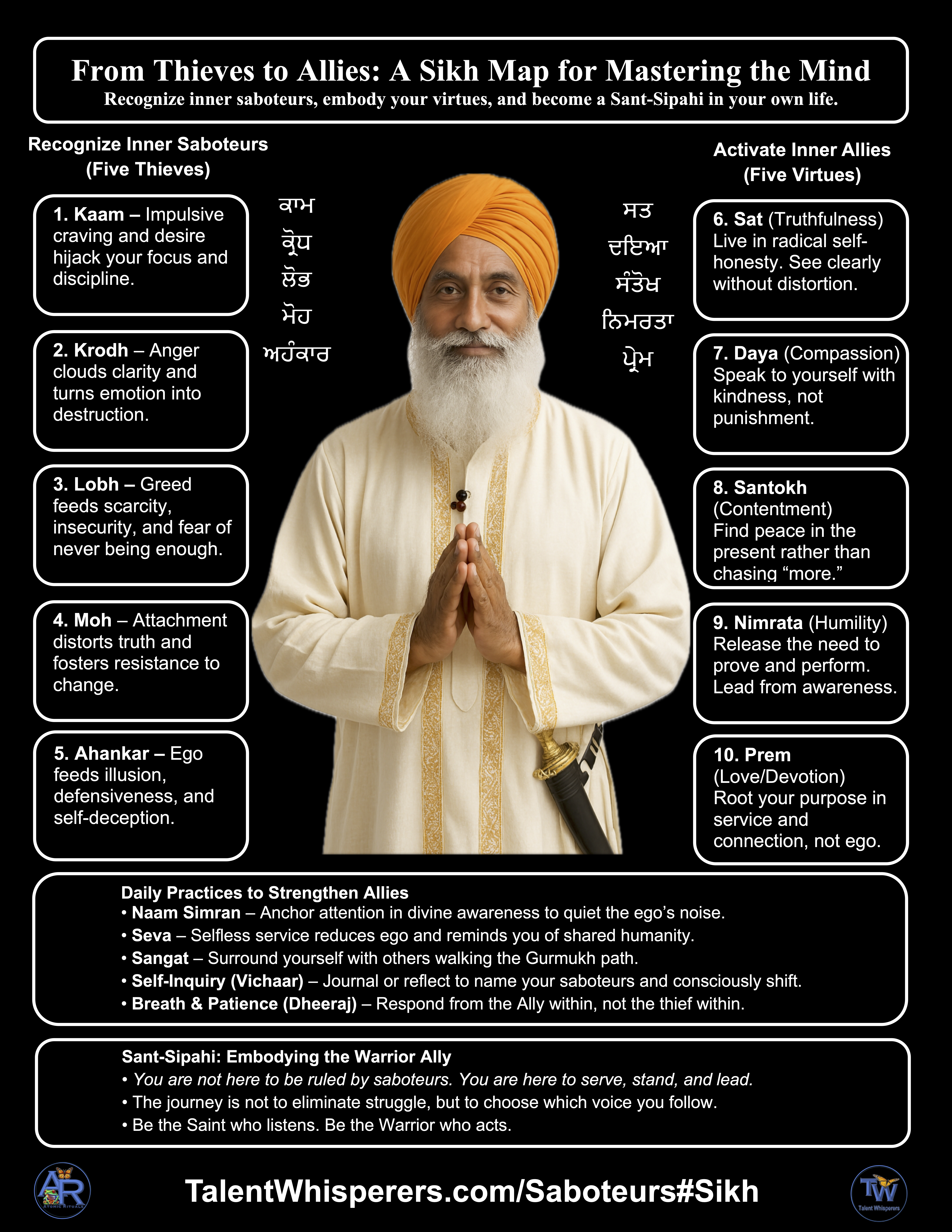
Visual guide exploring the five inner “thieves” and five balancing virtues, reflecting saboteur and ally dynamics in Sikh teachings
God as an Elephant: Sikh Perspectives on Partial Truth and Humility (Human Transformation)
An exploration of Sikh views on pluralism, Ik Onkar, Miri Piri, and humility through the metaphor of the blind men and the elephant, emphasizing how partial perspectives invite openness rather than certainty.
External Resources
Guru Granth Sahib (English Translation)
Primary Sikh scripture offering direct insight into Sikh views on humility, service, equality, and ethical conduct that inform leadership practice.
The Bhagavad Gita (English Translation)
A foundational Hindu text exploring duty, action, detachment, and responsibility through dialogue on leadership, moral tension, and right action.
Dharma Before Power: A Hindu Call for Just Leadership
A contemporary Hindu reflection on leadership that places dharma, moral duty, and service above authority, status, or political power. Drawing on thinkers such as Swami Vivekananda, Rabindranath Tagore, and K. M. Sen, this essay argues that leadership legitimacy must be earned through ethical conduct, empathy, and protection of pluralism. It offers a modern Hindu perspective that parallels Sikh views on responsibility, humility, and restraint, while grounding those values in Hindu traditions of moral self-governance and civic duty.
Equality – The nature of human life in Sikhism
Sikhism, as explored by the BBC Religions, centers on the authority of the eternal God (Waheguru) and the teachings in the Guru Granth Sahib, emphasizing equality for all humanity (regardless of gender, race, or caste) and selfless service (seva) through actions like the communal kitchen (langar) to honor God’s presence in everyone.
Pluralizing Pluralism: Lessons from, and for, India
Explores the possibilities and limits of covenantal pluralism in India, once heralded as a pluralist democracy, currently under the grip of Hindu supremacist authoritarianism. India’s historical record challenges key assumptions of theories of pluralist co-existence, illuminating problems and prospects for covenantal pluralism across the globe.